A parasitic flagellate among the Nucleariae: a new perspective on the phylogeny of Holomycota (Opisthokonta)

A parasitic flagellate among the Nucleariae: a new perspective on the phylogeny of Holomycota (Opisthokonta)
Seliuk, A. O.; Pozdnyakov, I. R.; Vishnyakov, A. E.; Drachko, D. O.; Karpov, S. A.
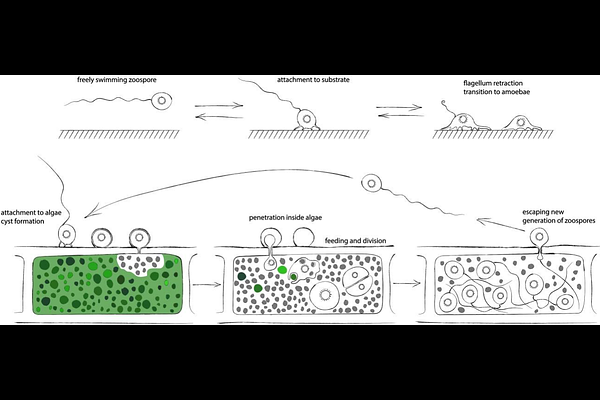
AbstractHolomycota, together with Holozoa, represents one of the two main branches of the supergroup Opisthokonta. Fungi, as well as three basal protist lineages Nuclearida, Rosellida, and Aphelida belong to Holomycota. Surprisingly, among all these holomycotan groups, only the most basal lineage, Nuclearida, lacks any traces of flagella in its life cycle and is represented by free-living amoebae, in contrast to the obligately parasitic and flagellated Rosellida and Aphelida, which evolved later. As the earliest-branching lineage, nucleariids play a key role in understanding the origin and diversification of Opisthokonta, which is presumed to have evolved from a uniflagellated ancestor. In this study, we describe the first known nucleariid that is parasitic on algae and possesses a flagellated stage in its life cycle. We studied the life cycle, and showed the ultrastructure of main life cycle stages of this parasite. The multigene phylogenetic tree based on the newly sequenced transcriptome demonstrated its basal position among nucleariids, forming a clade of environmental OTUs. This finding together with unique ultrastructural features, parasitic style of life, and presence of flagellum allowed us to describe a new species, genus, and family in the order Nuclearidida. We emended the diagnoses of the order, class, and phylum Nuclearida. Based on the ribosomal phylogenetic tree where the Insolitus nuclearius has a basal position among the nucleariids we discussed the evolution of this group from the uniflagellated ancestor and provided new insights into the early evolution of Holomycota in a whole, revising hypotheses regarding the opisthokont ancestor.