Bridgehead invasions of ambrosia beetles are structured by inbreeding and hybridisation

Bridgehead invasions of ambrosia beetles are structured by inbreeding and hybridisation
Schmidt, T.; Bierman, A.; Huisamen, E. J.; Terblanche, J. S.; Hoffmann, A. A.
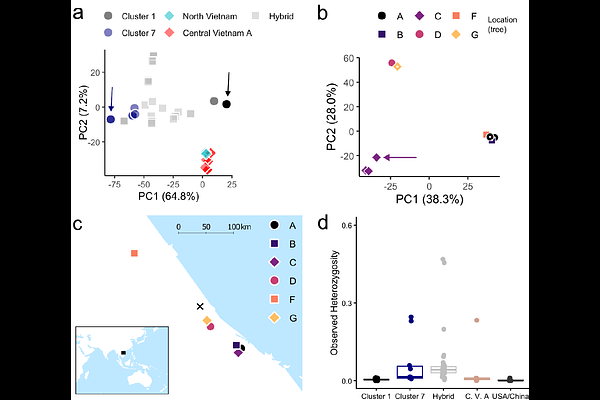
AbstractWhen invasive populations establish in regions far from their origin, they risk accumulating harmful mutations (genetic load) that limit population viability and subsequent spread. This may be exacerbated by the multiple, sequential bottlenecks experienced when invasions stem from a bridgehead population. However, populations may be able to purge genetic load when they can outbreed with other lineages from subsequent invasions. Here, we analyse global invasions of a species complex of persistently inbreeding ambrosia beetles, using genomic data (N=247) from invasive populations in Africa, North America and Australia, and from native populations in Asia. We focus particularly on one species of this complex (Euwallacea fornicatus) which poses a catastrophic threat to tree species worldwide and is rapidly expanding its global range. We uncover a single lineage of this species across South Africa, California and Western Australia, derived from an invasive bridgehead and containing almost no nuclear genetic variation. In South Africa we identify a second lineage that has repeatedly hybridised with the first lineage. Genetic patterns in the native range indicate that such opportunistic outbreeding may be common. Although purifying selection was evident in all lineages, native populations had fewer missense mutations than invasive populations, suggesting that opportunistic outbreeding may help purge fixed deleterious mutations when local lineage diversity is high. These findings show how inbreeding depression can affect populations even where inbreeding is common, and they highlight the biosecurity threat posed by subsequent gene flow into invasive populations.