Elevated substitution rates and increased purifying selection associated with thermophily in Chaetomiaceae fungi

Elevated substitution rates and increased purifying selection associated with thermophily in Chaetomiaceae fungi
Hensen, N.; CARON, T.; Hiltunen Thoren, M.; Johannesson, H.
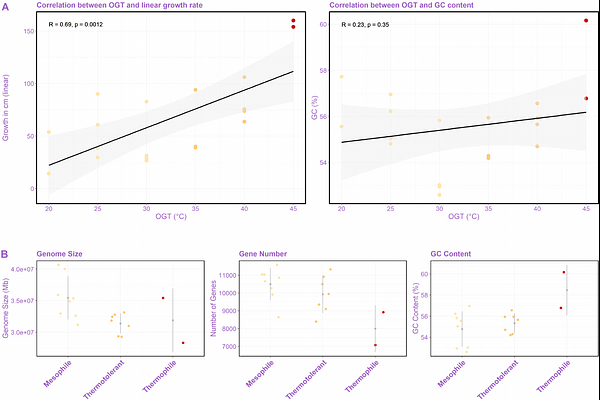
AbstractAbstract Understanding the genomic consequences of thermal adaptation in fungi is crucial, as rising global temperatures are expected to have negative impacts on food safety and human health. The family Chaetomiaceae contains a large number of thermophilic fungal taxa, but previous studies have reported inconsistent optimal growth temperatures (OGT) for the same strains, obtained with various laboratory methods. Here we applied a standardized laboratory approach to measure OGT across strains of 17 Chaetomiaceae species and used a phylogenomic approach to test associations between OGT, rates of genome evolution, and strength of purifying selection. Compared to mesophiles, thermophilic fungi showed faster nucleotide substitution rates. In addition, thermophiles showed lower dN/dS ratios than mesophiles, suggesting stronger purifying selection on conserved orthologs. We hypothesize that the elevated substitution rates are linked to high growth rates, as thermophilic fungi grew significantly faster than mesophilic ones. Our results show that selective pressures may act at different temperatures for distinct genomic characteristics. Genome size was lower at OGT at or above 35 degrees Celsius compared to mesophilic species, while GC content did not show a large difference between mesophiles and thermotolerant species, but increased in thermophilic species with an OGT of 45 degrees Celsius.