Humanization of the rpb9 locus in fission yeast reveals conserved and divergent roles of rpb9 and human POLR2I

Humanization of the rpb9 locus in fission yeast reveals conserved and divergent roles of rpb9 and human POLR2I
Finkel, J. M.; Williams, M. G.; Nirmal, M. B.; Pandey, S.; Howe, E. D.; Liu, C. T.; Lohman, J. R.; Sharma, N.; Vo, T. V.
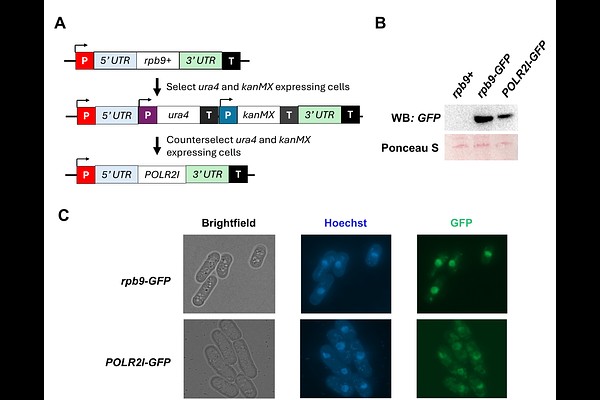
AbstractBackground/Objectives: RNA polymerase II is a multifunctional complex that is critical for gene regulation and environmental responses. Its POLR2I subunit in human is associated with various pathologies, including cancer chemoresistance. However, much of our understanding of how POLR2I could function indirectly derives from studies of its homologs in yeasts called Rpb9. Here, we endogenously humanized the rpb9 gene of the fission yeast Schizosaccharomyces pombe to examine the functional capabilities of POLR2I. Methods: We edited the genomic rpb9 locus in S. pombe so that it encodes the human POLR2I protein, and investigated functional and structural conservation. Results: With our humanized yeast system, we find widespread functional complementation by human POLR2I of S. pombe rpb9 roles in yeast growth, chronological aging, and stress responses. We also find that POLR2I complements novel roles for yeast rpb9 in facultative heterochromatin assembly, resistance against the chemotherapy 5-fluorouracil, and resistance against the fungicide thiabendazole. In contrast, we find that POLR2I cannot complement the role of rpb9 in resistance against the transcription elongation inhibitor 6-azauracil (6-AU) in our system. Interestingly, POLR2I could complement 6-AU resistance if ectopically expressed. Lastly, we observe extensive structural homology between Rpb9 and POLR2I proteins. Conclusions: Our study establishes an endogenous cross-species gene complementation strategy that uncovers both conserved and rewired functions of fission yeast rpb9 and its human homolog, POLR2I. In addition to validating conserved roles, we also identified conservation of previously unrecognized roles of rpb9 in heterochromatin formation and chemoresistance.