Fine-tuned synthetic transcription factors for production of 3' phosphoadenosine-5'-phosphosulfate in yeast

Fine-tuned synthetic transcription factors for production of 3' phosphoadenosine-5'-phosphosulfate in yeast
Borah, M.; Gu, S.; Saied, E. M.; Arenz, C.; Koffas, M. A.; Naseri, G.
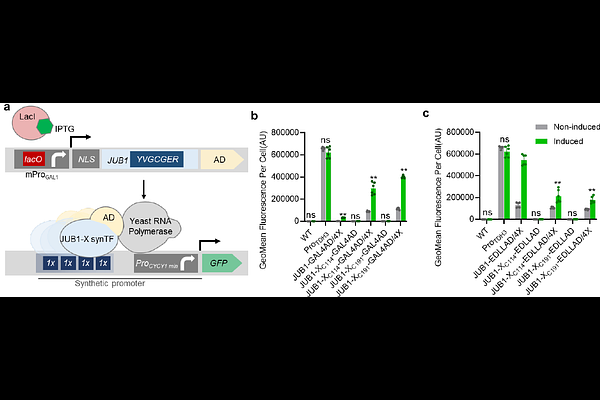
AbstractTechnologies developed over the past decade have made Saccharomyces cerevisiae a promising platform for producing various natural products. Balancing multi-enzyme expression, while maintaining robust microbial growth, remains a limiting factor for engineering long biosynthetic pathways in yeast. Here, we improved the transcriptional capacity of our previously developed isopropyl {beta}-D-1-thiogalactopyranoside (IPTG)-inducible synthetic transcription factors (synTFs) derived from the plant JUB1 DNA-binding domain. To this end, at cysteine positions within surface-exposed loop regions of a JUB1-derived DNA-binding scaffold, we introduced a short peptide to enhance loop flexibility while providing local stability and orientation. The generated synTFs, so-called JUB1-X synTFs, varying in strength, have been successfully used to improve the synthesis of 3'-phosphoadenosine 5'-phosphosulfate (PAPS), a universal sulfate donor necessary for the synthesis of bioactive molecules, including therapeutic glycosaminoglycans and sulfolipids. Using only this engineered yeast strain in simple batch culture, PAPS accumulation of 21.4 {+/-} 5.8 mg/g cdw was achieved after only 5 hours of inducing the expression of JUB1-X synTFs. Beyond PAPS production, the design principle demonstrated here provides a generalizable strategy to fine-tune other plant-derived synTFs, expanding the regulatory capabilities of existing synTF collections. Together, this work offers a modular, scalable approach to constructing high-performance gene circuits and supports the development of yeast cell factories for complex metabolic and synthetic biology applications.