Competition between mitochondrial and cytosolic ribosomes produces a bistable metabolic switch

Competition between mitochondrial and cytosolic ribosomes produces a bistable metabolic switch
Nanda, P.; Murray, A. W.
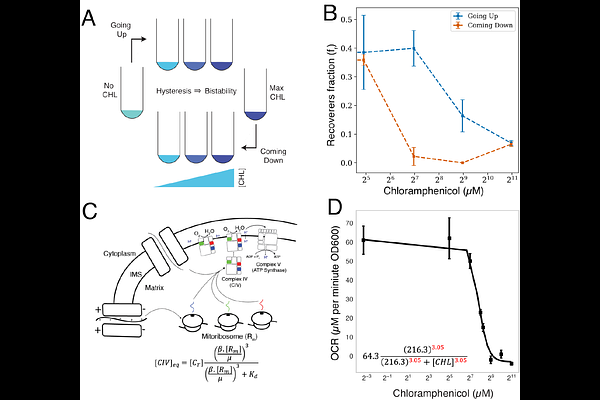
AbstractFast glycolytic growth in the budding yeast, Saccharomyces cerevisiae, produces two epigenetic states: arrestors, which primarily ferment, and recoverers, which respire. Positive feedback in mitochondrial translation produces the two states: mitochondrial membrane potential drives the import of positively charged nuclear-encoded proteins of the mitochondrial ribosome and mitochondrial ribosomes produce key electron transport chain subunits, sustaining the membrane potential and completing the positive feedback loop. The co-operative incorporation of three mitochondrially encoded and translated subunits of respiratory complex IV converts the positive feedback to a bistable switch. A single effective parameter determines bistability: the rate of mitochondrial protein synthesis, which produces complex IV, relative to the rate of cytoplasmic protein synthesis, which sets the rate of cell growth thus diluting mitochondrially synthesized proteins. Slowing mitochondrial protein synthesis increases the fraction of arrestors and slowing cytoplasmic protein synthesis opposes it. Reducing mitochondrial protein synthesis reconstitutes bistability in the evolutionary distant fission yeast suggesting a conserved, bistable switch enabling transitions between two metabolic strategies.