Pathogenic Leptospira in dogs and rodents in Tha Wang Pha, Thailand - Prevalence, diversity and linked environments

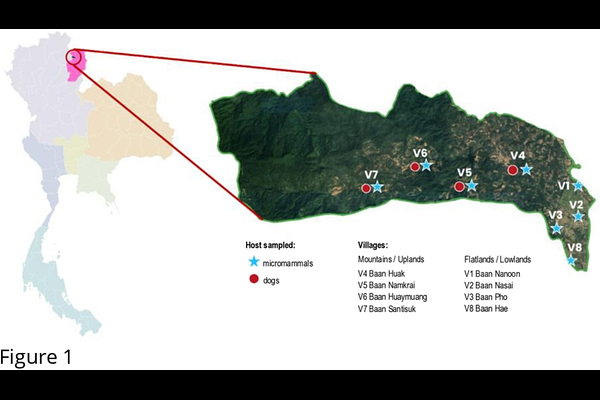
Pathogenic Leptospira in dogs and rodents in Tha Wang Pha, Thailand - Prevalence, diversity and linked environments
Jaiwung, W.; Dokhelar, T.; Morand, S.; Chaisiri, K.; De Garine-Wichatitsky, M.; Kritiyakan, A.; Guernier-Cambert, V.
AbstractHuman leptospirosis is a disease of public health importance in Thailand, but the animal species involved in the transmission cycle have not been fully uncovered. This study investigated Leptospira infection in dogs and terrestrial micromammals in rural Nan Province, Thailand, and the pathogen diversity. Sera from 95 seemingly healthy dogs and kidney samples from 399 micromammals were analyzed using real-time PCR for Leptospira detection, followed by conventional PCR and sequencing of infecting Leptospira. We investigated environmental factors associated with Leptospira infection in micromammals, using data collected during trapping. Real-time PCR revealed ongoing infection in 8.4% (8/95) of dogs and 10.0% (40/399) of terrestrial micromammals, with 12 infected species including Bandicota indica, Berylmys berdmorei, Berylmys bowersi, Mus cervicolor, Mus cookii, and Hylomys suillus. In this qPCR-positive micromammals, three pathogenic Leptospira species were identified: L. interrogans, L. weilii, and L. borgpetersenii. This represents the first confirmed detection of L. weilii in rodents in Thailand. Infected micromammals were found in agricultural and forest habitats but not in human settlements. Our study demonstrates potential complex leptospirosis epidemiology in rural Thailand, with multiple species serving as pathogenic Leptospira reservoirs across diverse habitats, and some shared pathogen diversity with human leptospirosis cases in Thailand. Free-roaming dogs may serve as bridge hosts, transmitting zoonotic Leptospira from micromammals to humans by visiting both animal habitats and human settlements. These findings emphasize the need for integrated One Health surveillance approaches to control leptospirosis in rural communities.