Chromosome, Plasmid, or Both: Short-Term Dynamics and Long-Term Outcomes of Plasmid Cost Compensation under Trade-Offs

Chromosome, Plasmid, or Both: Short-Term Dynamics and Long-Term Outcomes of Plasmid Cost Compensation under Trade-Offs
Witzany, C.; Bonhoeffer, S.
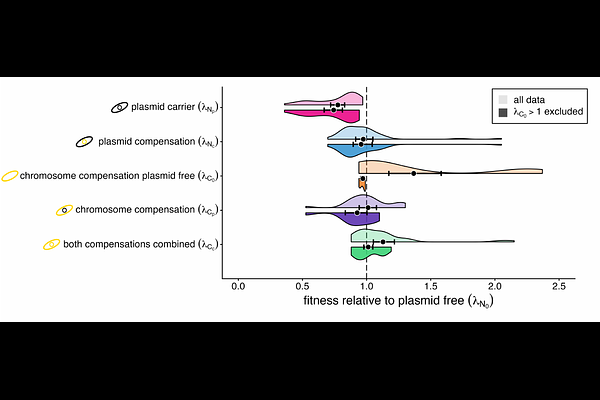
AbstractConjugative plasmids drive the dissemination of antimicrobial resistance genes and other conditionally beneficial accessory genes, but otherwise inflict fitness costs on their hosts that limit their spread. These costs can be ameliorated by compensatory mutations on the chromosome, the plasmid, or both combined (combined compensation). Mutants with plasmid-borne or chromosomal compensation differ in how they spread and compete, making the location of compensation an important determinant of plasmid and antimicrobial resistance (AMR) dynamics. We collate experimental data on plasmid-host co-evolution which, albeit limited, suggest compensatory benefits differ by location and are highest for combined compensation. We develop and analyse a mathematical model of compensatory evolution, finding that the long-term location of compensation is mainly determined by the highest cost reduction. Short term, however, succession dynamics arise from differences between locations: for instance, plasmid-borne compensation spreads horizontally, initially dominates, and can even facilitate the establishment of chromosomal or combined compensation. Strong trade-offs between compensation and either resistance or conjugation render compensation non-viable, but only conjugation trade-offs are location-dependent, disadvantaging plasmid-borne compensation and generating oscillatory dynamics. Our findings suggest plasmid-borne compensation may initially accelerate AMR-plasmid spread, whereas long-term chromosomal or combined compensation may enable hosts to accumulate multiple AMR-plasmids, promoting multidrug resistance.