Coupled Cell-Intrinsic and Microenvironmental Heterogeneity Drives Divergent Trajectories in Castration-Resistant Prostate Cancer

Coupled Cell-Intrinsic and Microenvironmental Heterogeneity Drives Divergent Trajectories in Castration-Resistant Prostate Cancer
Kemkar, S.; Tao, M.; Ghosh, A.; Ramamurthy, A.; Radhakrishnan, R.
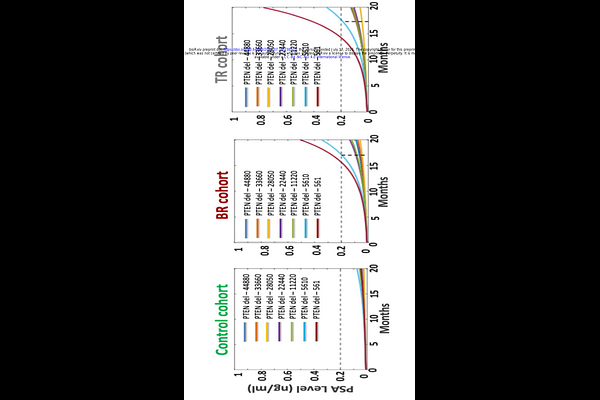
AbstractCastration-resistant prostate cancer emerges from coupling between cell-intrinsic heterogeneity and microenvironmental constraints. Mechanistically dissecting this coupling, rather than either factor in isolation, is the central aim of this study. To systematically study the effect of intrinsic and extrinsic spatial axes on disease trajectories, we developed an integrated multiscale framework: a cellular signaling model (MHS) parameterized with TCGA genomic data from control, biochemical recurrence (BR), and treatment-resistant (TR) cohorts, coupled to a spatial agent-based model (ABM). Machine learning surrogates trained on the MHS model identified PTEN, MDM4, and AR as dominant intrinsic drivers, using SHAP-based feature ranking. Clinical validation via Kaplan-Meier and Cox regression across cBioPortal cohorts confirmed these rankings: AR alterations (median OS 20 vs. 86 months), PTEN loss (54 vs. 77 months), and MDM4 amplification (33 vs. 75 months) predicted poor overall survival outcomes independently. At the tissue scale, ABM simulations were run to study the effect of microenvironmental (cell-extrinsic) factors such as physical confinement, androgen uptake kinetics, and adhesion-motility strength, on disease progression. This spatiotemporal analysis revealed that identical genetic alterations produce varied selection outcomes depending on microenvironmental context. Extending this coupling logic to the individual patient level, we parameterized the MHS model using gene expression profiles from 14 patients in the EUREKA1 prospective registry. Patient-specific androgen sensitivity ratios, the ratio of net cell growth under high versus low testosterone, stratified patients by model-predicted androgen dependence without requiring longitudinal PSA observations and showed that PTEN deletion shifts the proliferative response toward androgen independence in a patient-specific magnitude set by the broader expression background. This provides a model-based route from genomic data at diagnosis to personalized prediction of ADT resistance risk. Together, these findings establish that CRPC emergence is an emergent property of the intrinsic-extrinsic coupling, that neither molecular nor spatial analyses in isolation can predict clinical trajectories, and that mechanistic integration of both is required for accurate patient stratification.