Vicariance and dispersal shape the colonization history of the Galapagos carpenter bee, Xylocopa darwini

Vicariance and dispersal shape the colonization history of the Galapagos carpenter bee, Xylocopa darwini
McLaughlin, G. C.; Baquero-Mendez, V.; Pozo, M. J.; Torres, M. d. L.; Hollis, B.
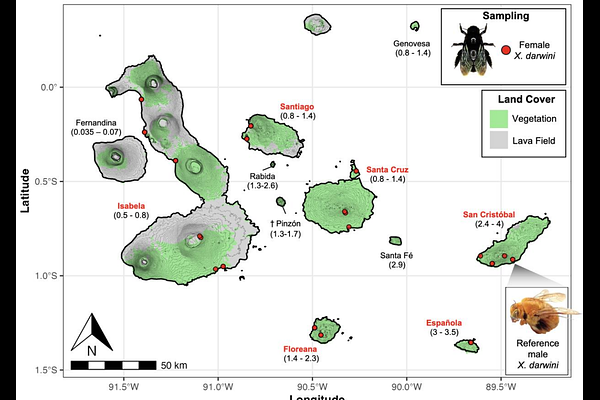
AbstractIsland colonization and subsequent diversification are often shaped by a complex interplay between organism-specific traits including dispersal capacity and ecological requirements, and the configuration of the landscape over geological time. Here, we investigate the evolutionary history and population genomics of the Galapagos carpenter bee, Xylocopa darwini, across six islands of the Galapagos archipelago. Despite the species strong flight ability, we find evidence of long-term isolation among all islands with the strongest divergence occurring between the eastern and western islands, and no evidence of contemporary gene flow between any island pairs. Our analyses indicate that the initial colonization of the archipelago by ancestors of X. darwini occurred during the early Pleistocene, a period when most current islands except for the youngest islands of Isabela and Fernandina, were subaerial. Diversification across the Galapagos islands closely tracks the timing of geological separation of the islands, with carpenter bees from the oldest eastern islands splitting first from the western clade over a million years ago. Subsequent diversification of the western clade tracks the sequential fragmentation of the western, central, and southern islands (Isabela, Santiago, Santa Cruz, and Floreana), rather than the geological age of the islands. Despite being on the oldest island, the bee population on Espanola appears to have been founded more recently (within the last 100,000 years) from San Cristobal, providing an exception to diversification tracking paleogeography. Measures of contemporary genetic diversity and runs of homozygosity (ROHs) suggest substantially smaller current population sizes on the southern island of Floreana and the eastern islands of Espanola and San Cristobal. These results are not consistent with a simple relationship between island area and genetic diversity and instead likely reflect a combination of evolution in isolation following vicariance, founder events following over-water dispersal, and possible episodes of secondary contact.