sRQA: AN INTEGRATIVE PIPELINE FOR SYMBOLIC RECURRENCE QUANTIFICATION ANALYSIS

sRQA: AN INTEGRATIVE PIPELINE FOR SYMBOLIC RECURRENCE QUANTIFICATION ANALYSIS
Curtin, A.; Merriman, E.; Curtin, P.
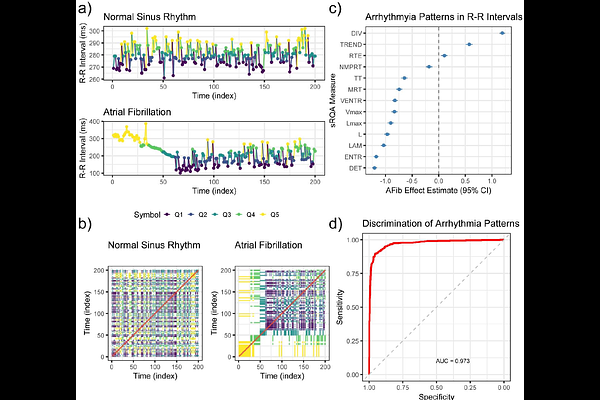
AbstractRecurrence Quantification Analysis (RQA) is a powerful phenomenological method for characterizing dynamical systems from sequential empirical data, but it is fundamentally limited to continuous signals. Symbolic RQA (sRQA) extends this framework to discrete state sequences, enabling the analysis of both inherently discrete systems and continuous systems where state-based dynamics and motifs are of interest. Despite its promise, accessible and unified software support for sRQA has remained limited. Here we introduce the sRQA package, an open-source R library that consolidates discretization and symbolization, data visualization, and computation of recurrence and cross-recurrence metrics into a single accessible toolset. We validated the method using simulated data with known dynamical properties, confirming that sRQA metrics behaved as theoretically expected. We then demonstrated the utility of sRQA across three real-world applications. First, we applied sRQA to ECG recordings, showing that symbolic recurrence metrics reliably distinguished atrial fibrillation from normal sinus rhythm, with an XGBoost classifier achieving 92% accuracy and an AUC of 0.97. Second, we applied sRQA to fMRI BOLD time series from the dorsal attention network, finding that symbolic and cross-recurrence metrics differentiated movie-viewing from resting-state conditions, revealing greater regularity and inter-subnetwork coordination during task engagement. Third, we applied sRQA to intrinsically symbolized sequences of pauses in speech, identifying valence-specific differences in pause dynamics between truthful and deceptive statements, as well as sex differences in pause structure during negatively-valenced speech. Together, these results demonstrate that sRQA provides a flexible and sensitive framework for characterizing discrete and discretized dynamical systems across biological and behavioral domains.