RPL38 controls 60S ribosomal subunit homeostasis to regulate start-codon stringency and frame selection during C9ORF72 RAN translation

RPL38 controls 60S ribosomal subunit homeostasis to regulate start-codon stringency and frame selection during C9ORF72 RAN translation
Mori, K.; Gotoh, S.; Kondo, S.; Fujino, Y.; Uozumi, R.; Miura, K.; Aoki, Y.; Tagami, S.; Akamine, S.; Miyamoto, T.; Nagai, Y.; Ikeda, M.
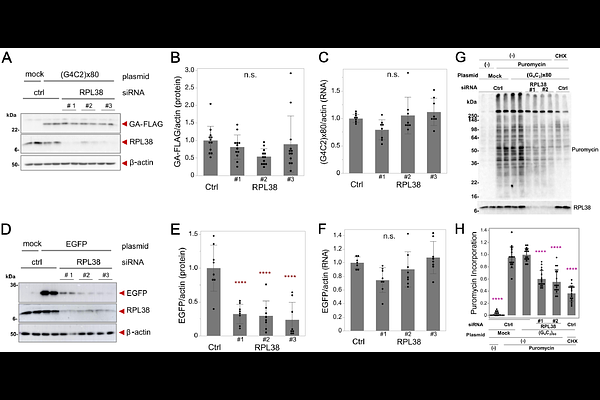
AbstractTranslation initiation depends on stringent start-codon recognition, yet how ribosomal states modulate initiation stringency remains incompletely defined. Repeat-associated non-AUG (RAN) translation is a non-canonical initiation pathway that generates toxic dipeptide repeat proteins in C9ORF72-associated frontotemporal dementia and amyotrophic lateral sclerosis (FTD/ALS). Here, we performed a dual-luciferase reporter-based siRNA screen to identify factors that differentially regulate canonical AUG-initiated and C9ORF72 RAN translation. We identified the 60S ribosomal protein RPL38 as a key determinant of translational output. RPL38 depletion selectively suppressed AUG-dependent translation while relatively preserving near-cognate-initiated RAN translation, resulting in a dose-dependent increase in the RAN-to-AUG translation ratio. Polysome profiling showed a selective reduction in large ribosomal subunit abundance without impaired subunit joining, consistent with defective 60S subunit homeostasis. Substitution of a near-cognate CUG start codon with AUG rendered translation sensitive to RPL38 depletion, supporting a role for ribosomal subunit availability in modulating initiation stringency. Graded RPL38 depletion altered frame usage within C9ORF72 repeat RNA. Consistent with these findings, RPL38 knockdown in the Drosophila eye enhanced GR-frame RAN translation while suppressing canonical AUG-dependent translation. Collectively, these findings identify 60S ribosomal subunit availability as a key determinant of start-codon stringency and frame selection in pathological C9ORF72 RAN translation.