Kinome-wide CRISPR/Cas9-knockout screening reveals critical protein kinases in vasopressin V2-receptor signaling

Kinome-wide CRISPR/Cas9-knockout screening reveals critical protein kinases in vasopressin V2-receptor signaling
Park, E.; Chen, L.; Raghuram, V.; Khan, S.; Murillo-de-Ozores, A. R.; Chou, C.-L.; Yang, C.-R.; Knepper, M. A.
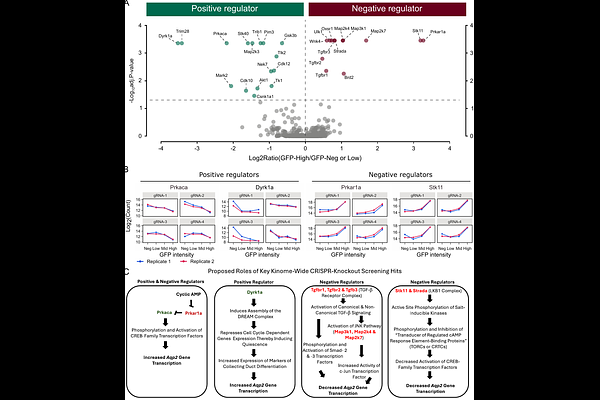
AbstractIdentification of signaling networks is an essential goal in systems biology. Here, we use CRISPR/Cas9 knockout screening (employing a whole kinome sgRNA library) to identify functionally critical protein kinases in a well-studied Gs-dependent G-protein coupled receptor (GPCR)-signaling model, namely the vasopressin V2 receptor (V2R) pathway. Screening was done using a specially-designed fluorescence-based reporter cell line with green-fluorescent protein (GFP) co-transcribed with Aqp2, a gene whose transcription is dependent on vasopressin-mediated activation of protein kinase A (PKA). Positive regulators (n=14) included PKA-catalytic subunit (Prkaca) and Dyrk1a (minibrain homolog). Negative regulators (n=12) included PKA-regulatory subunit type I, Stk11 (catalytic subunit of liver kinase B1 [LKB1] complex), and three TGF-{beta} receptor subunits (Tgfbr1, Tgfbr2, Tgfbr3) (see https://esbl.nhlbi.nih.gov/Databases/Kinome-CRISPR-screen/ for full list). Dyrk1a knockout cell lines failed to express AQP2 protein and exhibited a profound decrease in AQP2 mRNA. RNA-sequencing demonstrated widespread increases in cell-cycle transcripts, with a general defect in cell differentiation, accounting for AQP2 loss. TGF-{beta} exposure to un-transformed cells results in a profound decrease in V2R and AQP2 mRNA abundance along with multiple additional transcriptional targets of V2R-PKA signaling, consistent with prior findings in TGF-{beta}-mediated vasopressin escape. Stk11/LKB1 knockout lines displayed marked increases in AQP2 protein and mRNA, even in the absence of vasopressin. RNA-sequencing showed a marked similarity between the responses to Stk11/LKB1 deletion and vasopressin exposure in untransformed cells. Phospho-proteomic data point to opposing roles of Stk11/LKB1 and PKA in the regulation of cAMP-responsive transcriptional coactivator (CRTC) proteins in the transcriptional response to V2R-PKA signaling. Significance StatementCells throughout the body are regulated by extracellular signals like the hormone, vasopressin. Hormonal effects on cellular function are mediated by membrane receptors that trigger biochemical changes, often by inducing chemical modification of the amino acids making up individual proteins, such as addition of function-altering phosphate groups (phosphorylation). Protein phosphorylation is mediated by enzymes known as "protein kinases". Here, we have screened all known protein kinases using modern CRISPR/Cas9 technology to identify those involved in vasopressin action in the kidney. As expected from prior knowledge, the screen identified protein kinase A and one of its regulatory subunits, but also identified several protein kinases not previously implicated in vasopressin action in the kidney.