Large-scale, interpretable gene regulatory network inference through biologically informed matrix factorization

Large-scale, interpretable gene regulatory network inference through biologically informed matrix factorization
Micheletti, S.; Fanfani, V.; Vogt, J.; Quackenbush, J.; Fischer, J.; Marx, A.; Mandros, P.
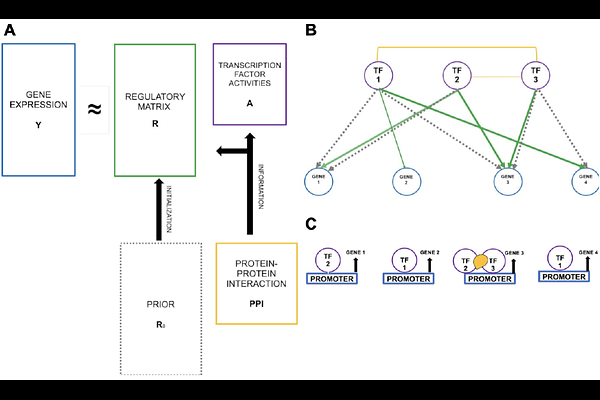
AbstractGene regulatory networks (GRNs) provide a mechanistic framework for understanding how transcription factors coordinate gene expression to establish cellular identity and phenotype. Methods that integrate gene expression with motif-derived regulatory priors and other sources of biological information have substantially advanced gene regulatory network inference by reconstructing condition-specific regulatory architecture. These approaches estimate the evidence supporting regulatory interactions and have proven remarkably successful in a wide range of biological applications. A complementary view of regulatory networks, however, seeks to estimate the effect of those interactions on gene expression itself, providing a framework in which regulatory edges can be interpreted as activating or inhibitory influences on transcription. We developed GIRAFFE, a biologically informed matrix factorization framework that jointly estimates transcription factor activities and gene regulatory networks by integrating gene expression, motif-based regulatory priors, and transcription factor protein-protein interactions. GIRAFFE estimates signed partial regulatory effects whose magnitude and sign can be interpreted as the strength and direction of transcriptional regulation. Building directly on the biological framework established by methods such as PANDA, GIRAFFE provides a complementary representation of gene regulatory networks that emphasizes mechanistic interpretation while remaining scalable, flexible, and computationally efficient. Across synthetic benchmarks, six human tissues, yeast transcription factor perturbation experiments, and liver hepatocellular carcinoma, GIRAFFE accurately reconstructs regulatory interactions while distinguishing activating from inhibitory regulation with high accuracy. The inferred networks recover known features of tissue-specific regulation, correctly classify regulatory effects in transcription factor perturbation experiments, and identify biologically coherent changes in regulatory programs associated with liver cancer. Together, these results demonstrate that estimating the direction of transcriptional regulation provides a complementary perspective on gene regulatory networks that facilitates biological interpretation and hypothesis generation.