Inbreeding depression is greater in benign than in stressful environments

Inbreeding depression is greater in benign than in stressful environments
Chan, Y. F.; Whitlock, R.
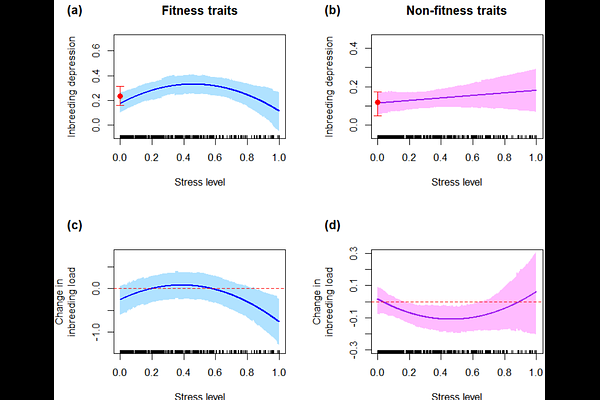
AbstractThe potential for environmental change to compound the detrimental effects of inbreeding depression in small and isolated populations is a significant concern in conservation biology. Previous evidence syntheses suggested that environmental stress exacerbates inbreeding depression, but were based on limited data. Here, we comprehensively test the relationship between inbreeding depression and environmental stress in natural populations using Bayesian mixed-effects meta-analysis on a large, high-quality data set of 2127 inbreeding depression effect sizes from animals and plants. Our results show that inbreeding depression is significantly higher in benign than in stressful environments. Analyses of both inbreeding depression and stress-induced changes in genetic load supported a unimodal (humped) relationship between the costs of inbreeding and stress intensity, with a peak at intermediate stress. At the highest levels of stress there was, on average, a significantly greater inbreeding load in benign than in stressful environments. We suggest that the lower cost of inbreeding associated with extreme stress results from constraints on the expression of inbreeding depression as fitness and phenotypes decline towards zero. Our findings help to resolve long-standing uncertainty around how inbreeding and environmental change interact, revealing that inbreeding responses vary non-linearly with environmental stress intensity, but showing that stress does not generally amplify inbreeding depression. As such, they will inform both the management of populations of conservation concern and predictions of species' responses to global environmental change.