Protein tertiary packing is nearly achiral

Protein tertiary packing is nearly achiral
Khare, S. D.
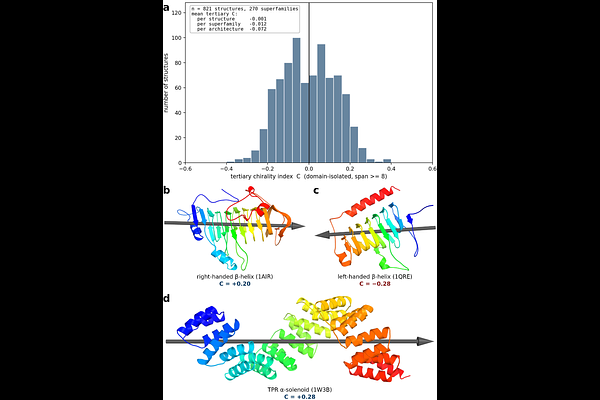
AbstractThe chirality of proteins originates at the C stereocentre of each L-amino acid, and is expressed in secondary structure as the consistent twist of -helices and {beta}-sheets. How far does this handedness propagate as secondary-structure elements pack into a tertiary fold? This question is central to the development of neural networks for the design of heterochiral and mixed-chirality proteins containing mirror-image D-amino acids. Such networks are most effectively trained on the far more abundant structural data available for natural all-L proteins, yet in practice they must generate and evaluate the reflected, D-configured counterparts, which are not explicitly represented in the training set. Here, I develop a spatial tessellation-based parity-odd descriptor, the signed volume of Delaunay tetrahedra (VD), to measure how chirality is distributed in protein structure. Reflecting a structure only flips the sign of any parity-odd descriptor, so the asymmetry of the VD distribution quantifies the chirality of a given sequence-local or tertiary structural element. I find that the signed Delaunay volume distribution within individual secondary-structure elements is strongly asymmetric, but this handedness largely cancels once elements pack against one another. The resulting tertiary distribution is nearly symmetric across a broad range of structures, from monomers to protein-protein and protein-ligand complexes. Individual folds can nonetheless be strongly handed at the tertiary scale, solenoid and repeat proteins most of all, yet across a broad sample of the fold universe this handedness cancels, leaving the ensemble near-achiral. Tertiary packing is therefore only weakly chiral, with the small residual handedness greatest at binding interfaces and near-zero in the buried core. How much chirality a model perceives in a D-protein is thus largely a choice of representation, a trade-off between reflection symmetry and the richness of structural information the representation retains. Because VD reduces the parity-odd content of each structural element to a single scalar while capturing tertiary protein packing, it offers a natural representation for the design of heterochiral complexes and mixed-chirality proteins.