UniST: A Unified Computational Framework for 3D Spatial Transcriptomics Reconstruction

UniST: A Unified Computational Framework for 3D Spatial Transcriptomics Reconstruction
Shui, L.; Liu, Y.; Julio, I. C. L.; Clemenceau, J. R.; Hoi, X. P.; Dai, Y.; Lu, W.; Min, J.; Khan, K.; Roemer, B.; Jiang, M.; Waters, R. E.; Colbert, K.; Maitra, A.; Wintermark, M.; Yuan, Y.; Chan, K. S.; Hwang, T. H.; Mansfield, P. F.; Davis, J.; Solis Soto, L. M.; Wang, L.; LI, L.; Li, Z.
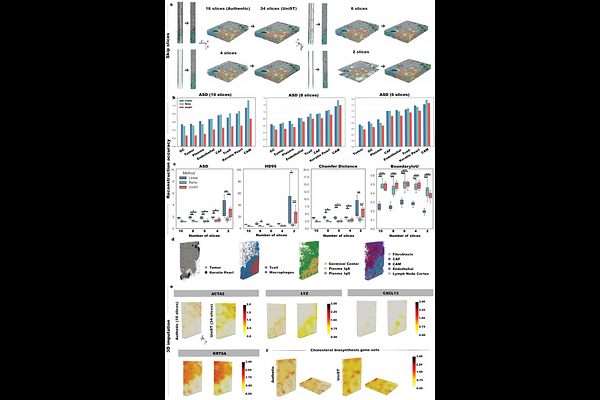
AbstractSpatial transcriptomics (ST) enables the measurement of gene expression in its native spatial context, yet most ST datasets are acquired as two-dimensional (2D) sections. Consequently, the underlying three-dimensional (3D) organization of tissues is only partially observed, and 3D ST data generated from serial sections are typically sparse and heterogeneous, with substantial tissue loss and missing measurements. These limitations pose major analytical challenges for reconstructing coherent 3D tissue architecture, rather than issues of experimental scalability alone. Here, we present UniST, a unified generative artificial intelligence (AI) framework designed to computationally reconstruct dense and continuous 3D ST landscapes from sparse serial sections, without altering the underlying experimental ST technologies. UniST integrates three complementary modules: kernel point convolution with cross-attention layers for point cloud upsampling, optical flow-based interpolation for continuous slice reconstruction, and a graph autoencoder with implicit neural representations for gene expression imputation. Together, these components densify sparse slices, resolve discontinuities, and map spatial coordinates to high-dimensional transcriptomics. Across multiple ST platforms and tissue contexts, UniST accurately restored structural continuity and biologically meaningful expression patterns. In a mouse embryo dataset, UniST reconstructed a dense 3D heart architecture from sparsely sampled slices. In two 3D human cancer tissues, UniST recovered critical spatial features, including tumor-immune boundaries and tertiary lymphoid structures, that were fragmented in the original data. By providing a generalizable computational solution that complements existing ST acquisition protocols, UniST facilitates cost-efficient and scalable reconstruction of 3D ST landscapes, enabling more faithful investigation of tissue organization and disease biology.