Hepatic HIF2α modulates extra-hepatic disease-associated phenotypes during metabolic dysfunction-associated steatotic liver disease

Hepatic HIF2α modulates extra-hepatic disease-associated phenotypes during metabolic dysfunction-associated steatotic liver disease
Holzner, L. M. W.; Korpershoek, R. M.; Niu, Y.; Cochrane, A.; Darwin, P. M.; Babuta, J.; Nazeer, A.; Castro, C.; Sowton, A. P.; Knapton, A. E.; Thackray, B. D.; Griffin, J. L.; Hall, Z.; Giussani, D. A.; Wüst, R. C. I.; Murray, A. J.
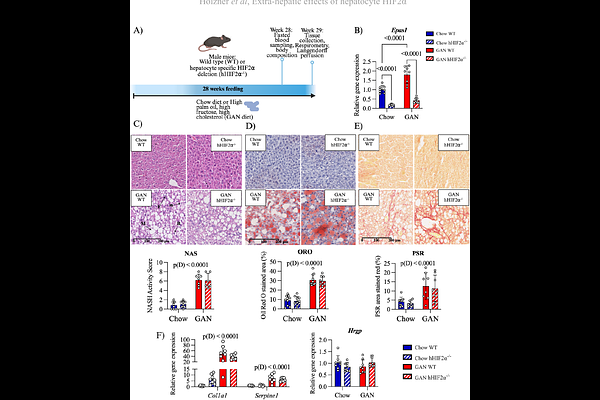
AbstractMetabolic dysfunction-associated steatotic liver disease (MASLD) afflicts more than one-third of adults globally, contributing significantly to an increased cardiovascular disease risk. Further, patients with severe liver disease experience muscle weakness (sarcopenic obesity) and fatigue. Hypoxia-inducible factor 2 (HIF2) accumulates in the livers of MASLD patients and has been implicated in disease progression. Here we sought to understand the role of hepatic HIF2 in mediating hepatic and extra-hepatic features of MASLD. Using a well-validated obese mouse model of MASLD, we investigated the impact of hepatocyte-specific HIF2 deletion (hHIF2-/-) on hepatic, cardiac and skeletal muscle metabolism, and cardiac function. Over 28 weeks, mice were exposed to a high-fat, high-fructose, high-cholesterol (GAN) diet, which induced obesity alongside hepatic steatosis, fibrosis and inflammation. In contrast to observations in lean mouse models of liver disease, hHIF2-/- did not protect against MASLD, despite greater hepatic NADH-supported mitochondrial respiration and higher intracellular sphingomyelin levels. Instead, in the hearts of GAN-fed mice, hHIF2-/- caused diacylglycerol accumulation independent of diet, accumulation of long-chain acyl-carnitines and exacerbation of ceramide accumulation. Langendorff-perfused hearts from hHIF2-/- mice showed systolic and diastolic dysfunction, including 24% lower left ventricular developed pressure and 34% lower maximal rate of relaxation (dP/dtmin). However, isolated hearts from hHIF2-/- mice were protected against MASLD-associated sympathetic dominance, determined using autonomic receptor agonist stimulation. Both GAN-feeding and hHIF2-/- were associated with lower lean mass (14% and 5.4% lower than respective controls), whilst hHIF2-/- enhanced OXPHOS-associated protein levels in gastrocnemius muscle. Overall, hHIF2-/- resulted in detrimental extra-hepatic effects, including myocardial lipid accumulation, impaired cardiac function, and loss of whole-body lean mass, with no apparent protection against MASLD disease progression.