Influence of Primary Coordination Sphere on Anion Rebound Selectivity in Nonheme Fe Enzyme-Catalyzed C(sp3)-H Functionalization: A Comparative Experimental and Computational Study of EgtB and ACCO

Influence of Primary Coordination Sphere on Anion Rebound Selectivity in Nonheme Fe Enzyme-Catalyzed C(sp3)-H Functionalization: A Comparative Experimental and Computational Study of EgtB and ACCO
Yang, Y.; Zhao, L.; Guo, R.; Mai, B. K.; Chen, H.; Liu, P.
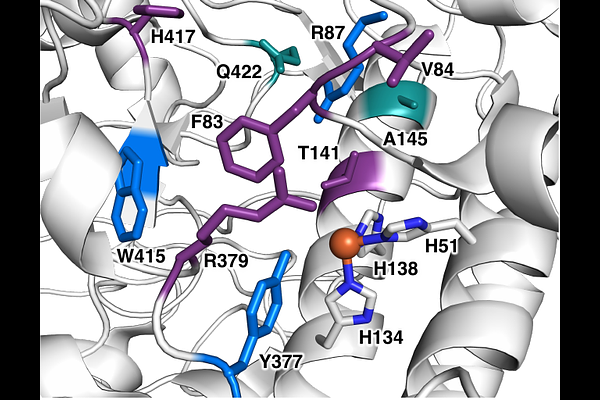
AbstractDeveloping enzymatic mechanisms for C-F bond formation remains a long-standing challenge. Here, we repurposed the biosynthetic nonheme Fe enzyme EgtB, which features a three-histidine facial triad, to catalyze C(sp3)-H fluorination reactions. Directed evolution of EgtB afforded two new-to-nature fluorine atom transferases with opposite enantiopreference, EgtBCHF1 and EgtBCHF2, with up to 28-fold improved total activity. In contrast to our previously evolved nonheme Fe fluorine atom transfer biocatalyst ACCOCHF, which contains a two-histidine-one-carboxylate facial triad, the evolved EgtBCHF variants displayed unexpected hydroxylation activity. 18O-labeling experiments showed that the hydroxy group originated from water rather than residual O2. Computational studies suggested that the three-histidine-supported Fe(III) center exhibits enhanced Lewis acidity compared to the two-histidine-one-carboxylate system, allowing deprotonation of Fe(III)-bound water to form a Fe(III)-OH species to catalyze radical hydroxylation. Primary coordination-sphere mutagenesis in EgtB and ACCO further supported the critical role of Fe coordination chemistry in controlling radical rebound reactivity and selectivity. Computational studies revealed that Fe coordination chemistry strongly influences both fluorine atom abstraction and radical rebound, with the intrinsic C-X (X = F, OH, and N3) bond forming radical rebound preference following the order N3 > OH > F. Furthermore, multivariate linear regression analysis revealed that fluorine atom abstraction is primarily governed by the intrinsic Fe-F bond strength, whereas fluorine rebound is predominantly controlled by the electronic structure of the Fe(III) intermediate. Together, these findings provide mechanistic insights into nonheme Fe enzymology and reprogramming toward selective radical rebound reactions, including challenging C-H fluorination.