A New Information Theoretic Approach Shows that Mixture Models Outperform Partitioned Models for Phylogenetic Analyses of Amino Acid Data

A New Information Theoretic Approach Shows that Mixture Models Outperform Partitioned Models for Phylogenetic Analyses of Amino Acid Data
Ren, H.; Jiang, C.; Wong, T. K. F.; Shao, Y.; Susko, E.; Minh, B. Q.; Lanfear, R.
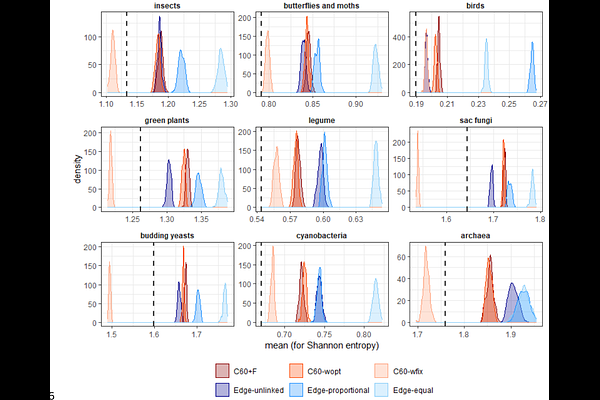
AbstractPartitioned and mixture models are widely employed in Maximum Likelihood phylogenetic analyses of large genomic datasets. Comparing the fit of the two types of models has been challenging, because standard information-theoretic approaches cannot be applied. Mixture models are increasingly popular for the analysis of amino acid datasets and can lead to different conclusions compared to partitioned models. This raises an important question - which type of model tends to perform better? Susko et al. (2026) recently introduced the marginal Akaike information criterion (mAIC), which allows mixture models and partitioned models to be directly compared for the first time. Here, we use the mAIC and a range of other approaches to compare the fit of mixture and partitioned models across a diverse set of empirical datasets. We show that mixture models are universally favoured on amino acid datasets. This has important implications for interpreting empirical analyses and suggests that continued development of mixture models is an important avenue for future research.