Paleometabolomics reveals impacts of abiotic factors on rodent midden metabolism over the last 50,000 years.

Paleometabolomics reveals impacts of abiotic factors on rodent midden metabolism over the last 50,000 years.
Dussarrat, T.; Diaz, F. P.; Gödde, V.; Persicke, M.; Cassan, C.; Rouveyrol, C.; Niehaus, K.; Petriacq, P.; Müller, C.; Latorre, C.; Gutierrez, R. A.
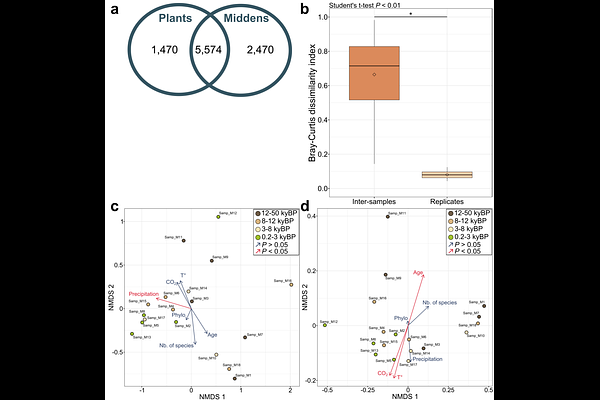
AbstractMetabolomics and paleoecology combined can reveal how past ecosystems worked, helping us predict future changes more accurately. Pioneering studies are needed to shed light on the potential of the so-called paleometabolomics and to standardise its application. Here, we deployed an untargeted metabolomic workflow on a timeline (200 to 49,600 cal yr BP) of rodent middens that efficiently and reproducibly captured rodent midden metabolic diversity, recovering 79% of the richness detected in 15 contemporary plant species. We found that midden chemical diversity and metabolites were influenced by the midden composition, age, and environment. Variation at the metabolite level in middens could fit age, past temperature and precipitation levels with an R2 > 88% and their plant composition. Compounds and families responding to climate variation included lipids (e.g. glycerophospholipids) and other metabolites linked to redox status such as phenolics (e.g. flavonoids, lignans). The responses of significant midden chemical indices and compounds to abiotic pressures were supported by their response in plants collected near the midden sites to temperature and soil water content across an elevation gradient. Overall, our results not only showcase paleometabolomics as a powerful tool to reconstruct past ecosystem dynamics and metabolic evolutionary trajectories, but also to uncover relevant chemical families that could serve as trackers of past -and potentially future- climate fluctuations.