Development of a High-throughput in vivo Assay for the Determination of Adenylation Domain Specificities

Development of a High-throughput in vivo Assay for the Determination of Adenylation Domain Specificities
Praeve, L.; Liu, J.; Zhou, Y.; Lonono Sanchez, O. N.; Wacker, A. B.; Bode, H. B.
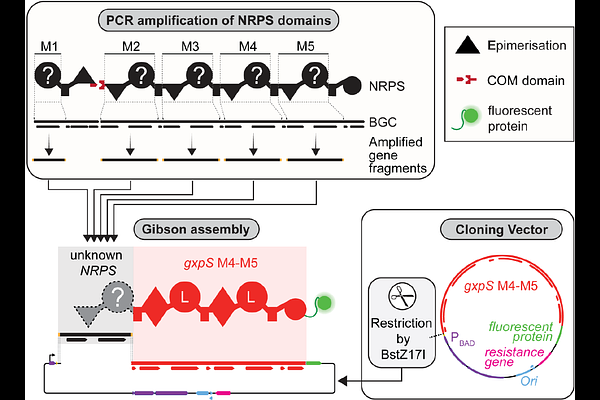
AbstractNatural product synthesis by non-ribosomal peptide synthetases (NRPS) is greatly defined by the substrate selectivity of the adenylation (A) domains. Previous assays for specificity determination were mainly performed in vitro and were requiring protein purification. In this work, we developed - based on NRPS engineering - a novel in vivo assay suitable for high-throughput application named ASCR (A domain screening). Using the recently described XUT fusion sites, A domains and their upstream condensation domains were assembled as di-domains to characterized NRPS model system, which allowed detection of defined tripeptide products via mass spectrometry directly after cell culture extraction. We evaluated the assay by screening in total 54 A domains from five known and seven uncharacterized NRPS, covering a broad range organism taxonomy and GC content of the investigated NRPS-encoding genes. Additionally, we applied the assay to elucidate and confirm the structures of novel cyclic pentapeptides derived from three novel NRPS from Photorhabdus temperata K122.