Development of a Matrix-Matched Calibration Curve for Multi-Site Quantification of Neu5Gc-Bearing N-Glycans

Development of a Matrix-Matched Calibration Curve for Multi-Site Quantification of Neu5Gc-Bearing N-Glycans
DeBono, N. J.; Moh, E. S.; Poole, J.; Packer, N. H.; Day, C. J.; Jennings, M. P.; Kolarich, D.; Ashwood, C.
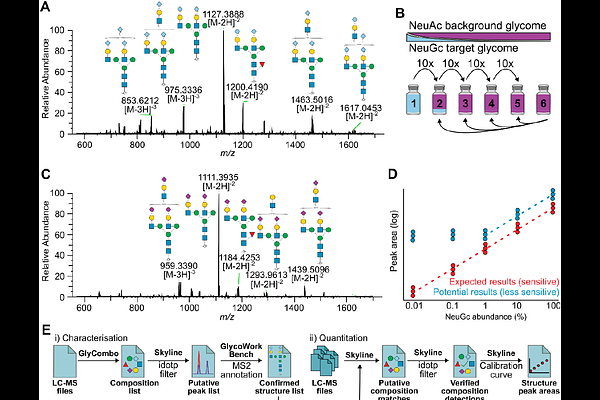
AbstractN-glycolylneuraminic acid (Neu5Gc) has been repeatedly associated with human cancer, but reliable detection has remained elusive, generating controversy regarding its presence in human samples. To address this, matrix-matched calibration curves, which have been pioneered in proteomics and metabolomics for assessing changes in complex mixtures, were measured of released N-glycans at four orders of magnitude dynamic range in defined mixtures, systematically benchmarking Neu5Gc-containing N-glycan detection across multiple LC-MS platforms and sites. Orthogonally, the gold-standard analytical method, consisting of fluorescence detection of labelled monosaccharides separated by LC, was applied to the same samples, yielding absolute concentrations of Neu5Gc. LC-MS demonstrated an extended detection range of three or more orders of magnitude while retaining intact N-glycan measurement, improving assay specificity and enabling detection of the variety of Neu5Gc-bearing N-glycans. By combining orthogonal dimensions of evidence, including chromatographic separation, isotopic distribution matching, and composition-confirming MS/MS, LC-MS confidently resolved Neu5Gc signals from noise, even at low abundance. In comparison, DMB-LC-FLR was limited to two orders of magnitude dynamic range, insufficient for detection of Neu5Gc in commercially available pooled human sera. These findings strongly support that DMB-LC-FLR assay specificity and sensitivity are insufficient for Neu5Gc detection in human samples due to noise overwhelming the Neu5Gc signal. By establishing a reusable benchmarking framework for future glycomic studies, we aim to use LC-MS to improve the measurement of Neu5Gc in clinical samples.