Recombination rate and efficiency of linked selection in small and large stickleback populations

Recombination rate and efficiency of linked selection in small and large stickleback populations
Wang, H.; Zhang, C.; Reid, K.; Merila, J.
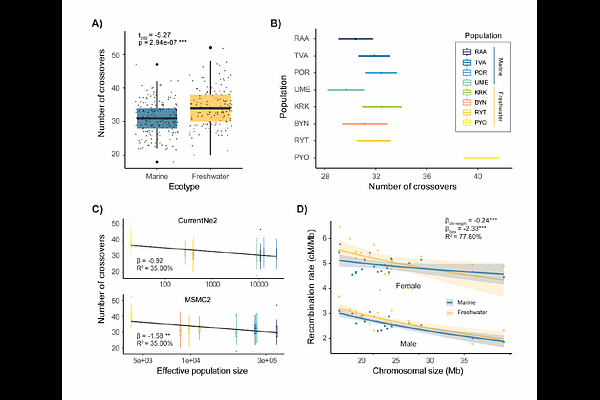
AbstractPopulation genetic theory predicts that natural selection will be more efficient in large than small populations because genetic drift reduces the efficiency of selection in small populations. Small populations adapting to new environments can also be expected to evolve higher recombination rates to facilitate adaptation as well as to dissociate and purge harmful mutations. We tested these hypotheses (1) by investigating differences in the strength of association between nucleotide diversity ({pi}) and recombination rate across the genomes of nine-spined sticklebacks (Pungitius pungitius) from four small freshwater (mean Ne {approx} 2 578) and four large marine (mean Ne = 86 742) populations, as well as (2) by comparing recombination rates between small and large populations using population specific linkage maps. We found the predicted positive correlation of {pi} with recombination rate from all but the smallest freshwater populations, suggesting prevalent linked selection even after accounting for variation in GC/CpG content, and gene density. Mean recombination rates did not differ between freshwater and marine populations, except that the smallest Ne freshwater population exhibited significantly elevated recombination rate. GWAS analyses suggested a polygenic basis for recombination rates. These results suggest an important role for linked selection in reducing {pi} in low recombination regions especially in large populations. Moreover, as predicted by theory, at least one of the small freshwater populations appears to have evolved a higher recombination rate than its marine ancestors.