Population and community responses to the fast, slow, and seasonal components of environmental variation

Population and community responses to the fast, slow, and seasonal components of environmental variation
Hernandez-Carrasco, D.; Koerich, G.; Gillis, A. J.; Harris, H. A. L.; Heller, N. R.; McCabe, C.; Lennox, R. S.; Shabanov, I.; Wang, L.; Lai, H. R.; Tonkin, J. D.
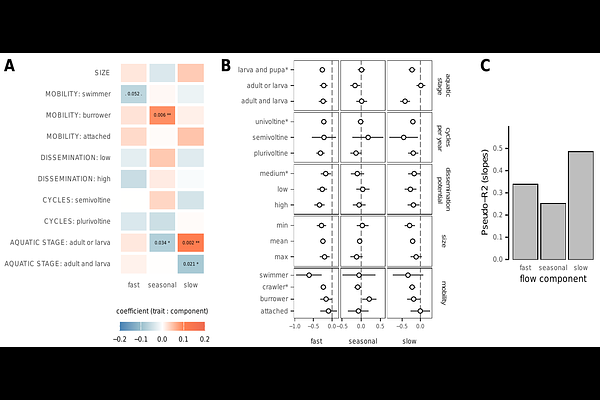
AbstractTheory suggests that different components of environmental fluctuations, from daily and seasonal cycles to multidecadal trends, can have distinct and even opposing effects on species' abundances and community dynamics, depending on their specific adaptations. But empirical research that deconstructs the influence of these different cycles on communities is lacking. Here, we used long-term biological monitoring data together with flow records of rivers across New Zealand to (i) investigate the role of fast, slow, and seasonal river-flow fluctuations in structuring macroinvertebrate communities; and (ii) to assess whether life-history and mobility traits mediate the response. Using joint species distribution models, we found striking differences in taxon and community responses to the different components of river flow variation. Responses to slow fluctuations were generally stronger and better predicted by traits, while responses to seasonal fluctuations were highly heterogeneous. Fast increases in flow, typical of flooding events, had pervasive negative effects on species abundances, but the severity of impact partly depended on mobility traits. Our results suggest that different ecological mechanisms underpin the response to distinct environmental fluctuations, highlighting the value of jointly considering multiple temporal scales of variation and species functional traits to understand and predict how communities reorganise under fluctuating environmental regimes.