Programming the Internal Architecture of Synthetic Compartments by Coassembling Filamentous and Liquid DNA Phases

Programming the Internal Architecture of Synthetic Compartments by Coassembling Filamentous and Liquid DNA Phases
Dizani, M.; Perlstein, B.; McGrory, D.; Afrose, S. P.; Agarwal, S.; Reese, T.; Franco, E.
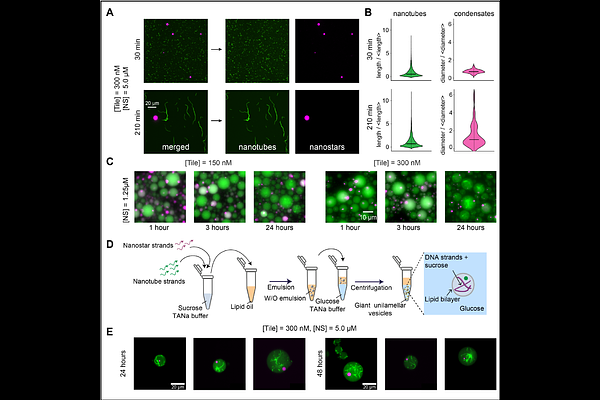
AbstractLiving cells rely on filaments and condensates as key organizers of their interior. Developing these structural primitives together inside synthetic compartments using programmable components is a step toward building functional synthetic cells, composite biomaterials, and synthetic tissues. Here, we demonstrate that DNA nanotubes and DNA condensates can be co-assembled within cell-sized compartments, including water-in-oil droplets and giant unilamellar vesicles (GUVs). The two nanostructures form as expected, producing a single condensate surrounded by nanotubes in diverse morphologies that depend on DNA and salt concentration, as well as compartment size. By incorporating photoactivatable DNA linkers, we can control the order of assembly and trigger reconfiguration of nanotube networks into ring-shaped bundles enclosing a condensate, architectures reminiscent of a cellular nucleus within a cytoskeletal ring. An isothermal assembly protocol based on monovalent salts further extends this approach to GUVs. Together, these results establish DNA filaments and condensates as programmable, composable organizers of synthetic cell interiors.