Rod pathway blockade improves visual function in a mouse model of photoreceptor degeneration

Rod pathway blockade improves visual function in a mouse model of photoreceptor degeneration
Taylor, W. R.; Puthussery, T.; Kulkarni, M.; Gayet, J.; Cosio, K.; Zheng, A.
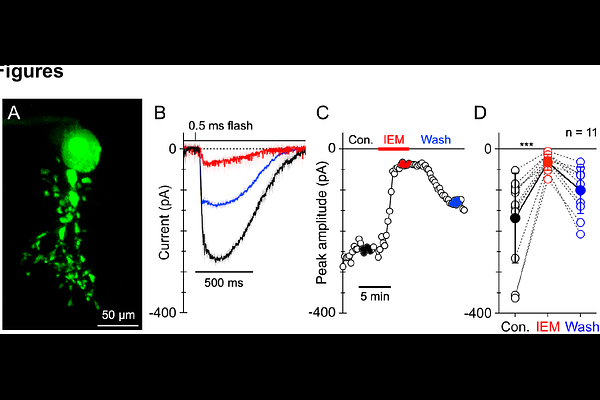
AbstractRetinitis pigmentosa (RP) refers to a group of inherited photoreceptor degenerations characterized by the initial death of rods and secondary loss of cones. In animal models of RP, retinal ganglion cells (RGCs) exhibit increased spontaneous activity that can mask residual photoreceptor signals and reduce the efficacy of treatments for vision restoration. AII amacrine cells (A2-ACs) are inhibitory retinal interneurons that propagate aberrant activity to RGCs, but it remains unclear whether rod or cone pathways drive altered A2-AC signaling or whether the relative contributions of these pathways changes with disease progression. We examined the circuit mechanisms underlying aberrant activity in the rd10 mouse model and found that blocking rod pathway input to A2-ACs suppressed aberrant activity and improved the signal-to-noise ratio of residual cone-driven responses in On- RGCs. The results also indicate that the On- but not the Off-pathway exhibits circuit-level compensation during the loss of photoreceptor input. The results suggest that pharmacological blockade of the rod pathway may improve residual cone-mediated function and improve the efficacy of vision restoration in rod-cone photoreceptor degenerations.