Directed evolution of the Fe-nitrogenase for CO2 reduction to hydrocarbons

Directed evolution of the Fe-nitrogenase for CO2 reduction to hydrocarbons
Oehlmann, N. N.; Schmidt, F. V.; Chen, J.; Prinz, S.; Zarzycki, J.; Claus, P.; Kahnt, J.; Erb, T. J.; Rebelein, J. G.
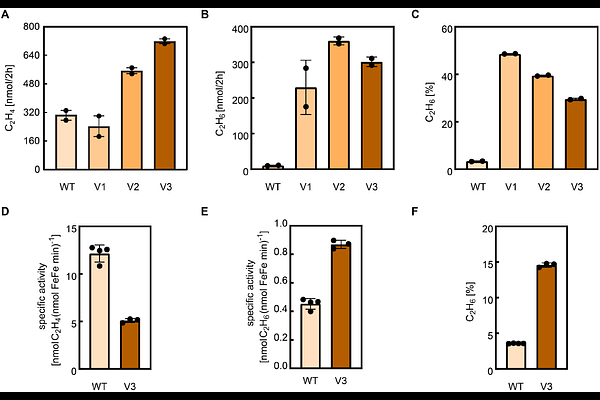
AbstractThe iron (Fe) nitrogenase drives bacterial methane (CH4) formation by converting carbon dioxide (CO2) to CH4 in a single enzymatic step. Enhancing the initial CH4 formation activity of Fe-nitrogenase and expanding the product spectrum to hydrocarbon chains could lead to a route for sustainable feedstock chemicals. Here, we performed the first directed evolution campaign on the Fe-nitrogenase aimed at optimizing the hydrocarbon production. We achieved an ~8-fold increase in CH4 formation by Fe-nitrogenase expressing Rhodobacter capsulatus cultures in three rounds of site-saturation mutagenesis. The best performing mutant (F362ManfD, Y85FanfD, T360SanfD) extends the in vivo product spectrum of the nitrogenase to ethane (C2H6) and exhibits 6-fold higher rates for CO production in vitro, whereas the formation of the undesirable byproduct formate was abolished. Electron microscopy-based structural analysis identified a methionine and water potentially stabilizing the transition state and fine-tuning the CO2 reduction mechanism and activity.