Genotype-by-environment-by-environment (GxExE) interactions have the potential to shape adaptation in response to multiple stressors

Genotype-by-environment-by-environment (GxExE) interactions have the potential to shape adaptation in response to multiple stressors
Britton, S. E.; Quintero, A. R.; Rozycki-Shah, S.; Rohner, P. T.
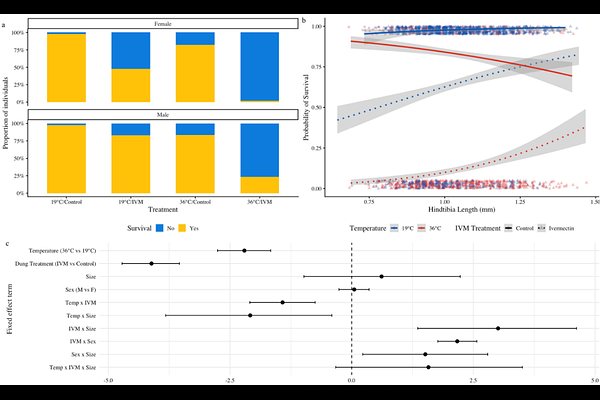
AbstractRapid adaptation in complex environments depends not only on the amount of genetic variation, but also on patterns of covariation among traits targeted by selection. Anthropogenic stressors create rapidly changing and multifaceted environments and provide powerful systems in which to investigate the potential for adaptation to multiple coinciding stressors. We investigate the combined effects of heat and chemical stress on survival in the black scavenger fly, Sepsis neocynipsea, and determine the genetic basis for resistance. In a fully factorial experiment, we expose isofemale lines to combinations of heat stress and ivermectin, a veterinary antiparasitic to which these flies are naturally exposed in agricultural landscapes. Using a Bayesian quantitative genetic approach, we estimate broad-sense genetic variation and cross-environmental genetic correlations. First, we show that these two stressors have synergistic effects on survival, with heat stress exacerbating the lethal effects of ivermectin. Second, we find that the largest component of genetic variation is the response to heat and ivermectin in combination (genotype-by-environment-by-environment; GxExE). Third, cross-environmental genetic correlations are weak, implying that relative genetic performance is dependent on the specific combination of stressors. Together, these results suggest that incorporating GxExE is essential for understanding adaptive potential in multi-stressor environments.