A New Fluorogenic Substrate for CYP1A2 and Its Application in Studying the Effects of Alcohol Exposure on Liver Drug Metabolism

A New Fluorogenic Substrate for CYP1A2 and Its Application in Studying the Effects of Alcohol Exposure on Liver Drug Metabolism
Gaither, K. A.; Davydova, N.; Ponraj, K.; Singh, D. K.; Prasad, B.; Davydov, D. R.
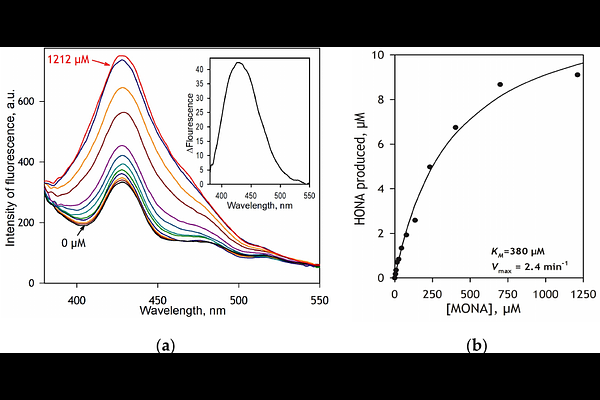
AbstractAiming to develop a high-throughput fluorometric assay for the activity CYP1A2, we introduced 6-Methoxy-2-naphthoic acid (MONA) as a new fluorogenic substrate for this important metabolizer of antidepressants and psychotropic drugs in human liver. We demonstrated that oxidative demethylation of MONA by liver microsomes results in a red shift and a substantial increase in fluorescence. This effect, which is exceptionally well pronounced at alkaline pH, allowed us to develop a sensitive and robust high-throughput assay of MONA metabolism. Probing the activity of 15 individual recombinant human P450 enzymes, we found that only two P450 species exhibited activity in MONA demethylation: CYP1A2 (kcat=11.9 {+/-} 2.2 min-1, KM=578 {+/-} 106 {micro}M) and CYP2A6 (kcat=0.48 {+/-} 0.07-1, KM=54 {+/-} 15 {micro}M). Since the KM values of the two enzymes are well resolved and the turnover rate observed with CYP2A6 is much lower than that of CYP1A2, this new fluorogenic substrate is useful as a specific probe for CYP1A2 activity in HLM. Importantly, MONA is not metabolized by CYP1A1 and CYP2C19, which distinguishes it from all known CYP1A2 fluorogenic substrates. We then used MONA to investigate the effects of chronic alcohol exposure on CYP1A2 activity using a series of 23 proteomically characterized individual HLM preparations from donors with various levels of alcohol consumption. The substrate saturation profiles (SSP) acquired with these preparations were subjected to global kinetic analysis by approximating them with combinations of two Michaelis-Menten equations with globally optimized KM values of 11 and 553 {micro}M. The amplitudes (Vmax values) of both components showed a pronounced increase with increasing alcohol exposure of the liver donors. The Vmax of the minor high-affinity component was best correlated with the abundance of alcohol-inducible CYP2E1 enzyme. The correlation was further improved by combining it with the abundances of CYP2A6 and CPR. This finding suggests that this minor component reflects the activity of CYP2A6 in the complex with alcohol-inducible CYP2E1 protein. In contrast, the Vmax of the predominant CYP1A2-catalyzed low-affinity component revealed a pronounced correlation with the abundances of CYP1A2 and NADPH cytochrome P450 reductase (CPR). These results suggest a considerable increase in the rate of metabolism of drug substrates of CYP1A2 by chronic alcohol exposure that takes place despite an alcohol-induced decrease in CYP1A2 expression.