5β-Dihydrotestosterone reveals a mutant androgen receptor vulnerability in prostate cancer

5β-Dihydrotestosterone reveals a mutant androgen receptor vulnerability in prostate cancer
Adams, S.; Phelan, L.; Lewis, T.; Behm, J.; Law, A.; Shi, X.; Li, G. F.; Li, J.
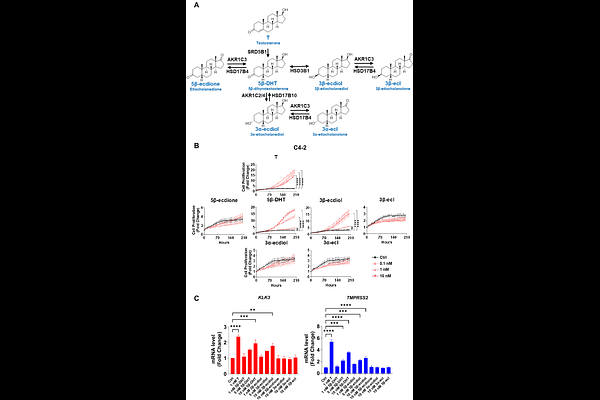
AbstractBipolar androgen therapy (BAT) exploits the paradoxical vulnerability of castration-resistant prostate cancer (CRPC) cells to rapid cycling between castrate and supraphysiologic androgen concentrations, but clinical BAT uses testosterone, which can also activate wild-type androgen receptor (AR) in androgen-responsive tissues, causing systemic side effects. 5{beta}-dihydrotestosterone (5{beta}-DHT) is a naturally occurring testosterone metabolite generally considered androgenically inactive because it binds wild-type AR weakly, yet its activity against clinically relevant AR mutants has not been systematically evaluated. Here, we tested whether 5{beta}-DHT and related 5{beta}-reduced testosterone metabolites activate AR signaling and growth programs in prostate cancer models that carry AR mutations. In C4-2 cells, 5{beta}-DHT and 3{beta}-etiocholanediol (3{beta}-ecdiol) increased canonical AR target genes, including KLK3 and TMPRSS2, with weaker activity than testosterone, whereas other 5{beta} metabolites showed limited activity. In androgen-responsive LNCaP and C4-2 models, 5{beta}-DHT and 3{beta}-ecdiol promoted cell growth under androgen-depleted conditions, and this effect was suppressed by enzalutamide, supporting AR dependence. RNA-seq confirmed that 5{beta}-DHT and 3{beta}-ecdiol induced androgen-response gene sets substantially overlapping with testosterone, albeit at lower transcriptional magnitude. Further, we found that 5{beta}-DHT, but not 3{beta}-ecdiol, suppresses cell proliferation of LNCaP, C4-2, and PC-3 cells stably expressing the clinically relevant AR gain-of-function mutants W742C and H875Y through activating AR-induced senescence-like features after high-dose exposure, consistent with the therapeutic logic of BAT. These findings identify 5{beta}-DHT as an overlooked mutant-AR agonist capable of BAT-like tumor suppression and propose it as a testosterone surrogate in BAT with potentially reduced systemic androgenic side effects.