A boundary-referenced framework for quantifying shoreline-associated movement in white sharks

A boundary-referenced framework for quantifying shoreline-associated movement in white sharks
Sexton, K. J.; Danko, E. F.; Cheung, N.; Digiacomo, A. E.; Sigman, J.; Kolyvek, K.; Holt, R. W.
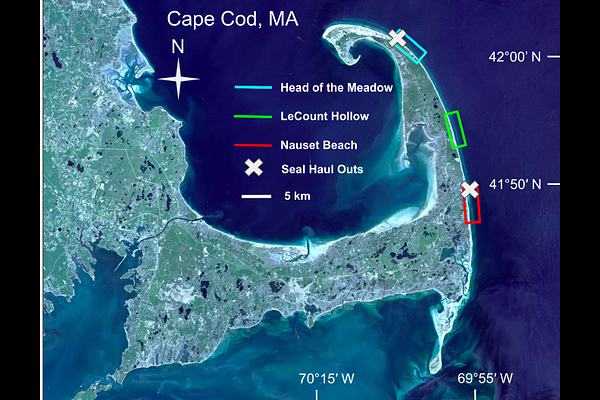
AbstractPersistent habitat edges can structure animal movement, yet many analyses treat boundary geometry only implicitly. Advances in aerial platforms, sensor miniaturization, and battery durations now enable high spatial and temporal resolution tracking, creating new opportunities to quantify fine-scale movements. We develop and apply a boundary-referenced framework to quantify movements of white sharks (Carcharodon carcharias) off of Cape Cod, Massachusetts, using ~50 hours of tracking data. Trajectories were analyzed in a local Cartesian coordinate system and a shoreline-referenced system in which displacement was decomposed into along-shore and cross-shore components. Four complementary metrics quantified path straightness, net and continuous alignment with the shoreline, and unique shoreline traversal. These metrics enabled movement modes to be defined directly from movement relative to the boundary. A parsimonious rules-based classifier recovered visually assigned modes with 88% leave-one-out cross-validated accuracy. Among 90 mode-separated tracks derived from tracks exceeding 15 min, nearly three quarters consisted primarily of sustained along-shore travel, whereas spatially confined movement and nearshore-offshore transitions were less frequent. Boundary-referenced metrics revealed site-level differences in shoreline alignment and space usage across beaches. Findings demonstrate that boundary-referenced metrics recover recurrent, interpretable movement modes in a large predator and provide a general framework for quantifying movements along environmental boundaries.