Synthesizing Mechanistic Hypotheses from Single-Cell Omics via Discretized Feature Attribution and Empirical Language Model Grounding

Synthesizing Mechanistic Hypotheses from Single-Cell Omics via Discretized Feature Attribution and Empirical Language Model Grounding
Chen, J.; Hong, Y.; Bermudez, A.; Hu, J.; Hsieh, C.-J.; Lin, N.
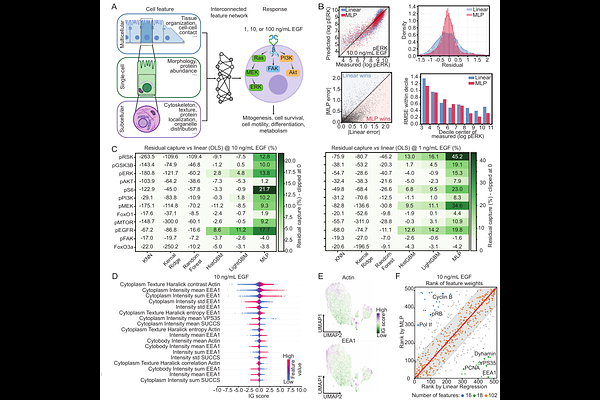
AbstractSingle-cell multimodal omics offer unprecedented resolution of cellular networks, yet translating continuous computational attributions into structured, testable biological mechanisms remains a persistent bottleneck. To address this limitation, we introduce an analytical pipeline employing decision trees to discretize continuous neural network attributions into explicit regulatory thresholds. These boundaries then structurally constrain large language models, enabling them to integrate established literature with empirical data to synthesize context-specific hypotheses. Applying this continuous-to-discrete framework across sparse datasets yielded novel biological mechanisms. Specifically, the framework articulated a cytoskeletal gating hierarchy governing EGF-stimulated pathways, identified transcriptomic drivers of input resistance in cortical interneurons, and delineated translational logic predicting Ki-67 abundance within spatial transcriptomics. Retrospective benchmarking validated the capacity of the framework to autonomously reconstruct published regulatory logic. Supported by a locally deployable open-weight language model and a code-free interface, this approach establishes an auditable methodology to extract robust experimental hypotheses from high-dimensional single-cell data.