Phenotypic and Genomic Evidence of Adaptive Tracking in Thermal Tolerance of Wild Populations of an Invasive Drosophila.

Phenotypic and Genomic Evidence of Adaptive Tracking in Thermal Tolerance of Wild Populations of an Invasive Drosophila.
McCabe, E.; Gautier, M.; Eller, K.; Garvin, M. O.; McCracken, A. R.; Redondo, S.; Bergland, A. O.; Bangerter, A.; Lotterhos, K. E.; Nunez, J. C. B.; Teets, N. M.
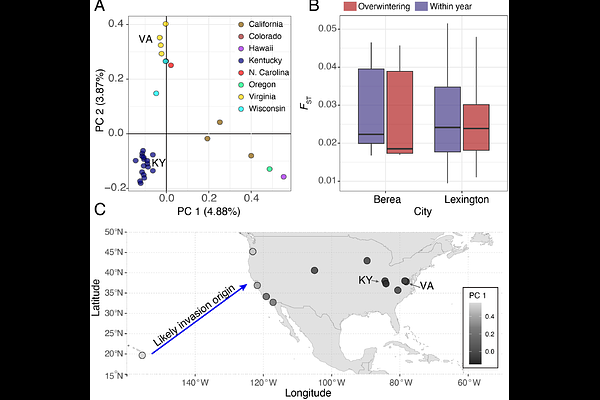
AbstractAdaptive tracking is an evolutionary process in which allele frequencies and phenotypes shift in response to temporally fluctuating environments. Currently it is unclear whether adaptive tracking causes predictable evolution of complex traits such as thermal tolerance. We investigated seasonal adaptive tracking of critical thermal minimum (CTmin) and genome-wide allele frequencies over multiple years in the invasive fly Drosophila suzukii. CTmin increased throughout the growing season, showing a lag of several generations between increasing temperature and evolutionary change. Genetic analyses indicate CTmin is highly polygenic, with little overlap between alleles associated with CTmin and other seasonally fluctuating alleles. Thus, polygenic traits may track seasonal environments without leaving strong genomic signals. By contrast, there were strong seasonal genomic signatures for alleles associated with oligogenic traits as such pesticide resistance and olfactory behavior. These findings suggest that seasonal adaptive tracking shapes a broad suite of traits that contribute to D. suzukiis invasion success.