Using semi-folded arenas to observe spontaneous emergence of collective trails in whole colonies of termites

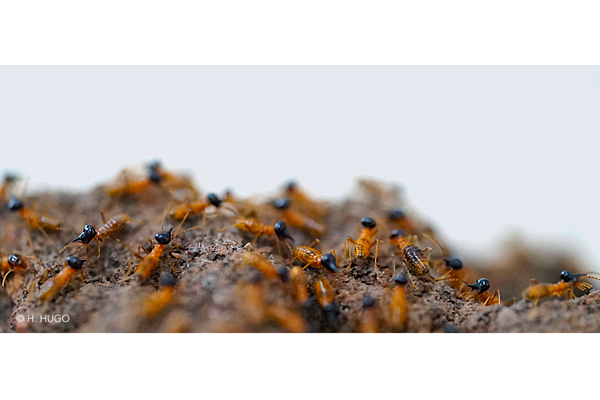
This preprint presents a semi-folded arena designed to enable observation and automated analysis of spontaneous collective trail formation in whole termite colonies under laboratory conditions. The method facilitates high-resolution tracking of colony-level movement while minimising spatial constraints that interfere with natural collective organisation.
Using semi-folded arenas to observe spontaneous emergence of collective trails in whole colonies of termites
Hugo, H.; Couzin, I. D.
AbstractCollective movement in social organisms emerges from local interactions and can generate large-scale spatial patterns of ecological relevance. In termites, trail formation is a well-known collective phenomenon, yet reproducing and recording its emergence under controlled laboratory conditions using whole colonies remains challenging. Existing laboratory approaches often rely on confined arenas or manually assembled subgroups, which can restrict movement and limit observation of colony-level dynamics. Here, we present a semi-folded arena designed for whole-colony observation of termite movement under controlled conditions. We developed a circular semi-folded arena that remained continuously connected to an intact nest and allowed individuals to move across a central observation surface while recirculating through a folded peripheral section. Using whole colonies of the Neotropical termite Constrictotermes cyphergaster, we recorded exploratory activity under baseline conditions, in the absence of added food or water. High-resolution video recordings were analysed using automated movement extraction to recover trajectories and visualise collective trail structure. Within the first 6 min of activity, collective trail structure was observed in 15 of the 16 colonies analysed. Under these conditions, the semi-folded setup captured early collective trail structure, visible as convergence of cumulative trajectories along shared routes radiating from the arena entrance region. Automated movement extraction was compatible with dense whole-colony recordings and yielded large quantities of positional data during the initial observation interval. Descriptive trajectory-based outputs, including speed distributions for workers and soldiers, showed that the recordings were suitable for recovery of fine-scale movement information. Repeatedly used routes were also often marked by visible dark traces on the paper lining by the end of the observations, providing a qualitative record of cumulative route use. The semi-folded arena provides a practical method for recording whole-colony termite movement under laboratory conditions while maintaining continuous nest access and avoiding manual transfer of individuals during trials. Rather than replacing conventional arena designs, this approach offers an additional methodological option for studying emergent movement patterns in species for which whole-colony observation is feasible. More broadly, it expands the experimental toolkit available for investigating colony-scale spatial organisation under controlled conditions.