Assessing the impact of renewable energy installations on biodiversity and identifying sustainable trade-offs

Assessing the impact of renewable energy installations on biodiversity and identifying sustainable trade-offs
Dahito, M.-A.; Shu, D. Y.; Wiest, G.; Moret, S.; Wechsler, T.; Pellissier, L.
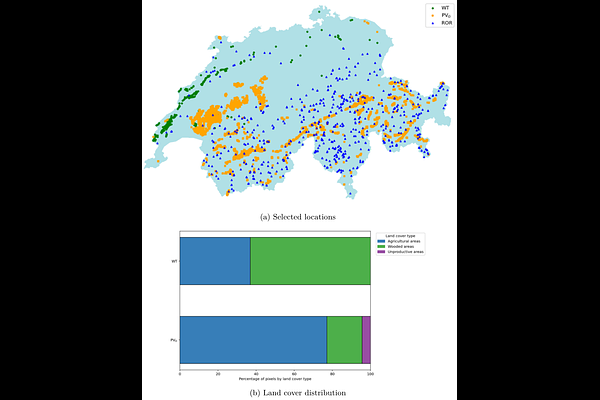
AbstractRenewable energy is crucial to achieve climate neutrality, but its rapid expansion can threaten biodiversity through habitat loss or fragmentation and ecological disruption. We present a spatially explicit assessment framework that quantifies biodiversity impacts from land use change associated with renewable energy infrastructure across a broad range of species groups, and identifies siting configurations that balance energy provision and conservation goals. Drawing on metrics from life cycle assessment, combined with species distribution models and siting strategies, we evaluate alternative deployment strategies. Using Switzerland as a case study, we compare three siting strategies (maximizing energy output, minimizing biodiversity impact, and a trade-off approach) for photovoltaic systems, run-of-river hydropower, and wind turbines. For solar and hydropower installations, prioritizing energy efficiency yields the highest cumulative biodiversity losses. However, these impacts can be substantially reduced with only a slight increase in land use by favouring biodiversity protection. For wind installations, strict avoidance of sensitive ecosystems may increase total impacts, as less efficient and therefore additional sites are required to achieve the same annual energy yield. Overall, our results show that trade-off-based siting strategies can effectively balance performance and biodiversity protection, highlighting that renewable energy can be provided without sacrificing sensitive ecosystems.