Distinct Effects of the Extracellular Matrix on Tumor Organization and Response to Cancer Virotherapy

Distinct Effects of the Extracellular Matrix on Tumor Organization and Response to Cancer Virotherapy
Supino, I.; Visscher, F. E.; Boerma, A.; Wouters, A. K.; Joshi, M.; Heemskerk, M. H.; Bhatt, D. K.
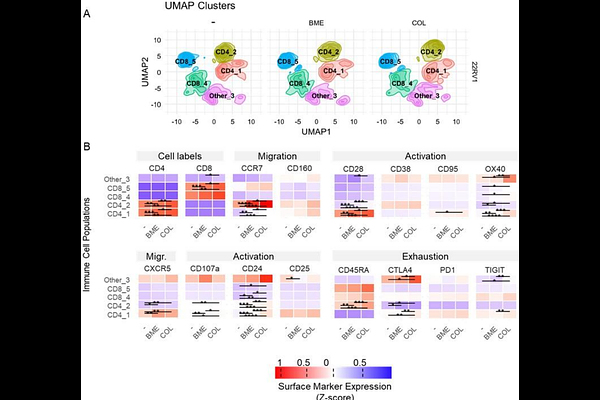
AbstractExtracellular matrix (ECM) regulates tumor architecture and immune accessibility, but its impact on virus-based anticancer therapies is not well understood. In particular, ECM modulation leads to both enhanced and impaired therapeutic outcomes in vivo, reflecting the complexity of matrix-immune-virus interactions. Here, we combine computational modeling with empirical 3D tumor spheroid-immune in vitro co-cultures to examine how ECM composition and abundance shape an Alphavirus replicon-based therapy. We show that ECM-induced changes in tumor spheroid architecture vary by cell-adhesion phenotype but higher matrix abundance consistently reduces cellular density. Notably, increasing abundance of basement membrane extract or Collagen-I reduced tumor spheroid cell density, which generally enhanced viral infection, T cell activation, and IFN{gamma} production. However, reduced immune accessibility in collagen-rich environments suppressed immune responses despite improved infection, highlighting matrix-specific effects. Our findings provide insights into ECM's role in virus-based therapies and propose a bottom-up framework for systematically evaluating its influence on therapeutic efficacy.