Mating display plasticity predicts the biogeography of complex communication and population persistence in changing climates

Mating display plasticity predicts the biogeography of complex communication and population persistence in changing climates
Leith, N. T.; Woods, J. P.; Fowler-Finn, K. D.
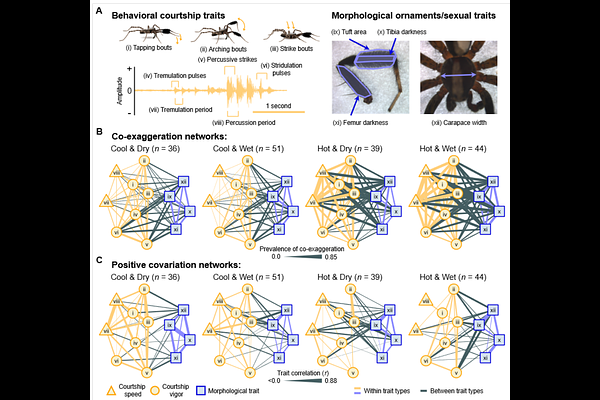
AbstractAnimals often produce complex combinations of signals to enhance display detection, interpretation, and the information conveyed during communication. Combined signals can serve many functions in communication systems, but we know little about how signal combinations initially evolve and why they often vary in complexity across broad geographic gradients. Here, we show that environmentally driven changes in the coordinated production of multiple signals determine whether the signals can interact in functional ways, and thereby shape the capacity for selection to favor increased display complexity. Our behavioral experiment in a focal species of Schizocosa wolf spider reveal that shifts to hotter and wetter environments can enable males with exaggerated morphological ornaments to also produce exaggerated courtship behaviors, allowing these signals to interactively affect mating success. Congruently, phylogenetic analyses show that species in hotter and wetter regions of North America have repeatedly evolved more complex courtship displays alongside exaggerated morphological ornaments. Biogeographic analyses further suggest that geographic gradients in display complexity may arise not only from in situ evolution, but also from more frequent establishment of species with complex displays in hotter and wetter regions. Finally, we found that species with complex displays were more likely to persist in areas that have faced more severe climate warming and intensified precipitation in the last 50 years--conditions that should enhance the functioning of complex mating displays for reproductive success. Altogether, our findings reveal a novel association between plasticity in inter-signal interactions and variation in the complexity of communication systems across scales of biological organization.