Gene Expansion and Regulatory Rewiring Shape Sex-Biased Evolution of the Mouse Submandibular Gland Secretome

Gene Expansion and Regulatory Rewiring Shape Sex-Biased Evolution of the Mouse Submandibular Gland Secretome
Landau, L. J. B.; Jain, S.; Griffin, N.; Saikia, A.; Kramer, J. M.; Knox, S.; Ruhl, S.; Gokcumen, O.
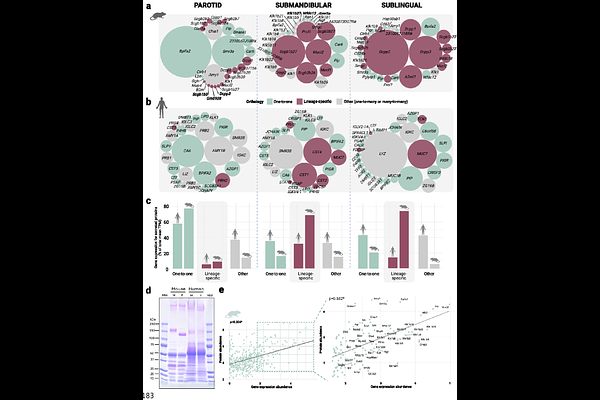
AbstractMammalian saliva plays essential roles in digestion, immunity, and host-microbiome interactions, yet its protein composition varies across species and sexes. The evolutionary mechanisms underlying this molecular diversity remain poorly understood. Here, we compared mouse and human salivary gland secretomes at genomic, transcriptomic, and proteomic levels to understand how saliva composition evolves. We performed RNA-seq analysis of the major mouse salivary glands (parotid, submandibular, and sublingual), liver and pancreas from both sexes, compared them with reanalyzed previously published human salivary gland transcriptomes, and integrated them with proteome data of mouse and human whole saliva. We found that evolution of gene expression in mouse salivary glands is driven by rapid gene turnover and sexual dimorphism. In the submandibular and sublingual glands, respectively, 68% and 73% of expression from genes encoding secreted proteins derives from lineage-specific genes that lack one-to-one human orthologs. Mouse submandibular gland shows striking sexual dimorphism, with 1537 tissue specific sex-biased genes, five times higher than in the liver, a classic model of sex-biased expression. These genes cluster in regions shaped by recent gene duplication, such as the kallikrein gene cluster, a mouse-specific expansion that accounts for ~16.4% of male-biased submandibular expression. Our analyses suggest that this bias arises through regulatory changes that are expanded by gene duplication, including the spread of a testosterone-associated regulatory motif and the expansion of a shared chromatin domain that promotes coordinated gene regulation. Our results reveal how lineage-specific gene duplication and regulatory rewiring drive rapid, sex-specific evolution of the mammalian salivary gland secretome.