Standing Genomic Variation inferred by popGWAS Predicts Seedling Drought Survival Experiment in Fagus sylvatica

Standing Genomic Variation inferred by popGWAS Predicts Seedling Drought Survival Experiment in Fagus sylvatica
Eberhardt, L.; Reuss, F.; Pfenninger, M.
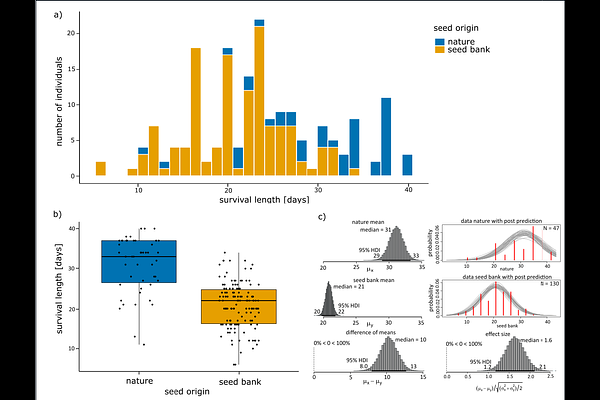
AbstractIntensifying drought regimes across Central Europe, driven by global climate change, pose an increasing threat to forest regeneration, with the seedling stage representing the primary demographic bottleneck for long-lived tree species such as Fagus sylvatica. While intraspecific phenotypic variation in drought resistance among beech seedlings has been documented, the genomic basis of this variation remains poorly understood. Existing provenance trial approaches capture broad-sense heritability but lack the resolution to identify specific causal loci. To address this gap, we conducted a controlled soil drought experiment with Fagus sylvatica seedlings and applied a population-level genome-wide association study (GWAS), and leveraged individual survival length as a direct fitness proxy. We detected substantial variation in survival duration (10-40 days) among populations, with corresponding allele frequency differences at candidate loci whose functional annotations partially reflect known responses to environmental stress. Notably, seedlings sourced from an official seed bank consistently underperformed relative to wild-collected material, suggesting that current seed sourcing practices may inadvertently deplete adaptive genetic diversity. Our results demonstrate that standing genomic variation in natural Fagus sylvatica populations predicts differential seedling drought survival, and that the species retains substantial genetic potential to cope with prolonged spring drought when natural genetic diversity is preserved. These findings have direct implications for assisted migration strategies and seed sourcing guidelines under projected climate scenarios.