Sulfur amino acid restriction prevents S-adenosylmethionine-driven liver steatosis, hepatocellular carcinoma, and metabolic remodeling in high-fat-fed GNMT-null mice

Sulfur amino acid restriction prevents S-adenosylmethionine-driven liver steatosis, hepatocellular carcinoma, and metabolic remodeling in high-fat-fed GNMT-null mice
Hampton, G. S.; Ortega, A. F.; Vang, C. M.; Rome, F. I.; Goelzer, M.; Lantier, L.; Hughey, C. C.
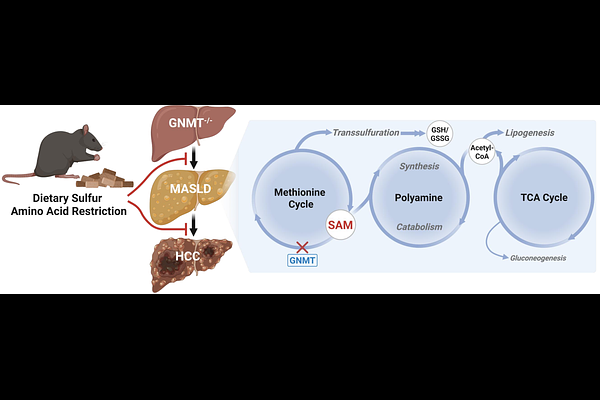
AbstractThe expression of glycine N-methyltransferase (GNMT), a critical regulator of S-adenosylmethionine (SAM) levels, is down-regulated in humans with metabolic dysfunction-associated steatotic liver disease (MASLD) and hepatocellular carcinoma (HCC). In low-fat-fed mice, GNMT knockout (KO) induces liver steatosis that progresses to HCC. This is accompanied by increased SAM and a shunting of tricarboxylic acid (TCA) cycle intermediates away from gluconeogenesis to other biosynthetic pathways that support lipid accretion and tumorigenesis. The objective of this study was to test whether this metabolic remodeling persists in GNMT KO mice with diet-induced obesity and to determine if the liver pathophysiology and metabolic dysregulation are dependent on elevated SAM. To accomplish this, GNMT KO mice and wild-type (WT) littermates were fed a high-fat control or high-fat sulfur amino acid restricted (SAAR) diet to mitigate SAM accumulation. 2H/13C isotope infusions in mice quantified in vivo liver glucose and TCA cycle fluxes. Metabolomics, respirometry, and pyruvate tolerance tests were completed to more fully interpret the 2H/13C metabolic flux analyses. KO mice had impaired gluconeogenesis sourced from TCA cycle intermediates. A concurrent elevation in metabolites of pathways that use both SAM and TCA cycle intermediates indicated increased liver polyamine turnover, transsulfuration, and de novo lipogenesis. Importantly, SAAR prevented the increase in SAM, the associated metabolic dysregulation, and the appearance of liver steatosis and HCC. In conclusion, the results of these experiments suggest that the loss of GNMT in mice with diet-induced obesity rewires metabolism in a SAM-dependent manner that precipitates liver steatosis and the transition to HCC.