Pan-cancer NET-associated immunothrombosis coupling identifies a neutrophil-linked but neutrophil-irreducible tumor ecology

Pan-cancer NET-associated immunothrombosis coupling identifies a neutrophil-linked but neutrophil-irreducible tumor ecology
Zhang, L.
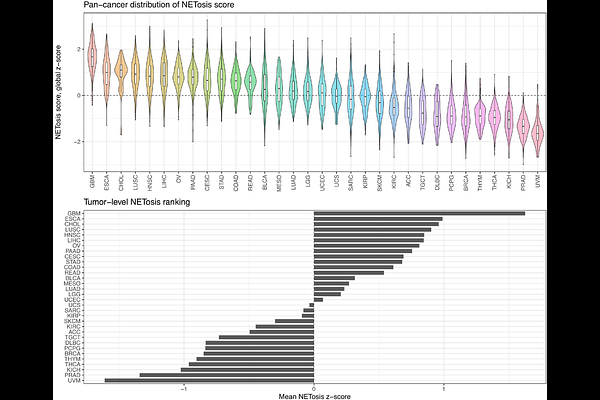
AbstractBackground: Neutrophil extracellular traps (NETs) connect innate immunity with thrombosis, metastasis and immune escape, but bulk-tumor NET-associated signatures may mainly report neutrophil abundance. We tested whether an established NETs score also captures a neutrophil-irreducible tumor ecology. Methods: We reanalysed a published 19-gene NETs score in 9,496 TCGA tumors across 32 cancer types. Tumor-stratified correlations mapped Hallmark and custom immunothrombosis modules. Within each cancer type, the score was residualized against a curated neutrophil proxy and partitioned into four median-defined ecological quadrants. Clinical survival and two independent immune-checkpoint-blockade cohorts provided outcome context. Results: Raw NETs score was positively associated with TNF-alpha/NF-kB signaling in 32/32 cancers (median Spearman rho=0.404; FDR<0.05 in 30) and hypoxia in 32/32 (median rho=0.394; FDR<0.05 in 31). After neutrophil residualization, hypoxia (median rho=0.206; positive in 30/32) and TNF-alpha/NF-kB signaling (median rho=0.165; positive in 29/32) remained dominant. NETs-high/neutrophil-low tumors retained myeloid-inflammatory, immunothrombotic and hypoxic enrichment. Residual NETs score was associated with adverse overall survival in eight of 23 evaluable cancers after available clinical adjustment. It did not discriminate response in IMvigor210 (AUC=0.519, P=0.642) or GSE91061 (AUC=0.527, P=0.808), although it differed across IMvigor210 immune phenotypes (P=0.045). Conclusions: The published NETs score contains a neutrophil-linked yet incompletely neutrophil-reducible component that organizes hypoxic, inflammatory and immunothrombotic tumor ecology. Its translational value is context dependent rather than that of a universal standalone immunotherapy biomarker.