eIF4E and Ezrin cooperate in pseudopods to drive a localized migratory translation program in acute myeloid leukemia

eIF4E and Ezrin cooperate in pseudopods to drive a localized migratory translation program in acute myeloid leukemia
Kraljacic, B.; Martinez, L. M.; Retiz, A.; Perron, S.; Shi, N.; Embree, C. M.; Yip, W.; Trujillo-Alonso, V.; Chu Carty, M.; Lassman, E.; Alilovic, K.; Carreno, S.; Roboz, G. J.; Guzman, M. L.; Borden, K. L. B.
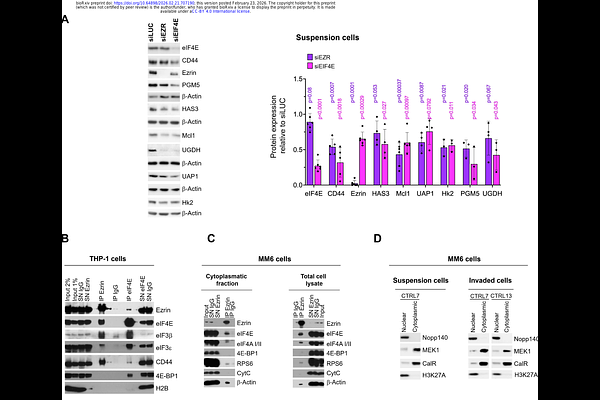
AbstractAggressive subtypes of acute myeloid leukemia (AML) are characterized by increased migratory behavior and poor prognosis prioritizing the need for uncovering relevant mechanisms. While attributed to transcriptional changes, these AMLs manifest dysregulated eIF4E implicating disrupted mRNA metabolism. Here, we observed in AML mouse models, patient specimens, and cell lines that eIF4E drives motility, colonization, engraftment and AML progression. AML cells migrate utilizing Ezrin-positive pseudopods. Unexpectedly, we discovered that eIF4E interacts with Ezrin, that these physically associated factors are required and cooperated to drive an on-demand translation program in pseudopods for motility. Indeed, pseudopods were sites of eIF4E- and Ezrin-dependent translation by implementing the first method to directly mark active ribosomes in situ (Visualizing Translation Activity using RiboLace, VISTA-R). Biochemically, Ezrin bound eIF4E, ribosomal components, and mRNAs consistent with our observed Ezrin-dependent modulation of protein production. This unprecedented physical coupling of motility and translation provisions migratory sites to sustain AML progression.