Summertime Fog and Dew Impacts on Vegetation Depend on Aridity

Summertime Fog and Dew Impacts on Vegetation Depend on Aridity
Lolos, I.; Abatzoglou, J. T.; Terry, T. J.
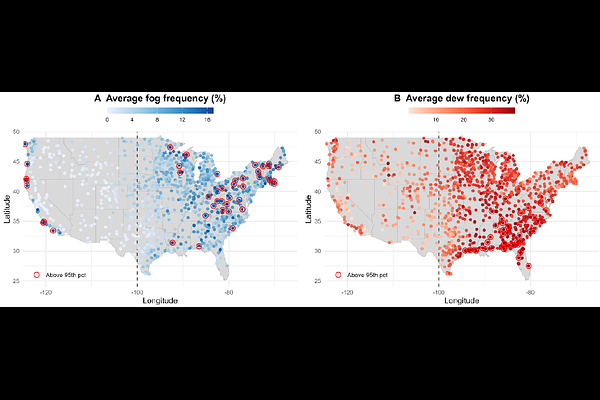
AbstractRainfall and vapor pressure deficit (VPD) are well-studied hydrological variables that largely determine aboveground net primary production (ANPP) in most ecosystems. Meanwhile, the impacts of another important part of the hydrologic cycle, non-rainfall water from fog and dew, remain poorly understood at the ecosystem level. To fill this gap, we used meteorological variables measured at weather stations along with satellite-derived vegetation greenness data from surrounding areas to examine how fog and dew frequency affect summer plant growth across the contiguous United States. Our analysis shows that, even after accounting for precipitation, VPD, and land-cover type, fog and, more so, dew enhanced vegetation productivity in water-limited regions. In contrast, non-rainfall water had a neutral or negative impact on plant growth in humid regions, with fog showing the strongest and most widespread negative effects. Taken together, our findings reveal that summertime non-rainfall water has differential effects on vegetation that are largely determined by ecosystem-level water availability. These aridity-dependent effects of fog and dew should be considered in future ecological and agricultural studies and in assessments of projected climate impacts on vegetation.