Morphomechanically-Informed Spatial Curvature Sequencing in Prostate Cancer

Morphomechanically-Informed Spatial Curvature Sequencing in Prostate Cancer
Kordic, I.; Rivera Moctezuma, F. G.; Amiri, H. A.; Liu, A.; Cai, S.; Ali, M. N. R.; Brea, L.; Venkataraman, A.; Shi, H.; Harik, L.; Sulchek, T. A.; Yu, J.; Coskun, A. F.
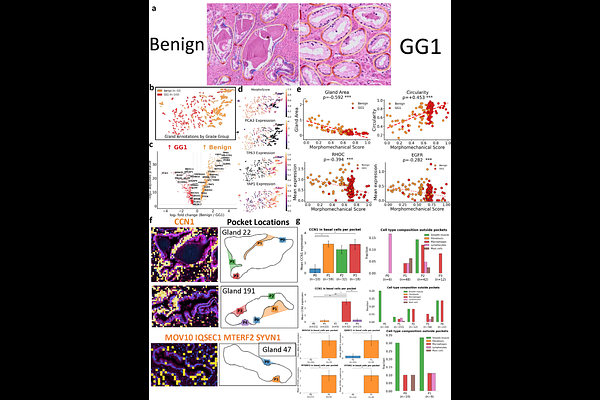
AbstractMorphological changes in prostate glands, assessed by Gleason grading, remain the gold standard for diagnosing prostate cancer, yet molecular biomarkers associated with gland shape are not well understood. Here, we introduce CurvSeq, a mechanomorphology-informed framework for spatial sequencing data, and CurvSee, its complementary version for proteomic and imaging datasets. These methods integrate gland boundary curvature, pocket architecture, microenvironmental composition, and molecular profiles to study morphomechanical relationships in prostate adenocarcinoma. Using five independent spatial transcriptomic and multiplexed imaging datasets, we segmented individual prostate glands, extracted gland contours, quantified local curvature and pocket-like concavities, and projected these features onto spatially resolved gene and protein measurements. In Xenium data, CurvSeq distinguished benign and GG1 glands, identifying cancer-associated genes such as PCA3 and AMACR in GG1 glands and basal, basement membrane, and mechanotransduction-associated programs in benign glands. In Visium data, a diffusion-based morphomechanical score ordered benign glands by area, circularity, pocket number, smooth muscle abundance, immune-cell proximity, and remodeling-associated genes including MMP7. In GG4 glands, CurvSeq identified neuroendocrine-like boundary regions associated with MMP7 expression, COL1A1-rich adjacent stroma, and immune-cell accumulation. Finally, CurvSee extended this framework to multiplexed protein imaging, where combined morphology and protein-expression features distinguished Gleason-associated gland states. Together, CurvSeq and CurvSee provide a quantitative framework for linking gland architecture, local microenvironment, and molecular state, showing that prostate gland morphology can be integrated with spatial omics to identify morphomechanical niches associated with cancer progression.