A genetically encoded local learning rule enables physical learning in engineered bacteria

A genetically encoded local learning rule enables physical learning in engineered bacteria
Prakash, S.; Varela, C.; Walsh, M.; Galizi, R.; Isalan, M.; Jaramillo, A.
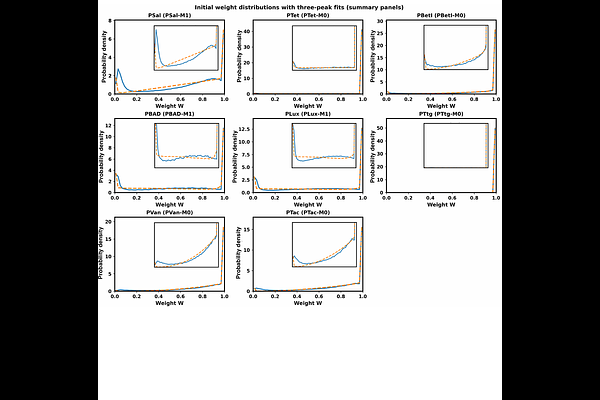
AbstractTraining physical neural networks directly in matter remains difficult because most platforms do not implement weight storage and weight update within the same physical substrate. Here we show that engineered Escherichia coli can implement a genetically encoded local learning rule acting on a persistent biological memory. In memregulons, analogue weights are stored as plasmid copy-number ratios in a coupled two-plasmid system and are rewritten by activity-dependent growth bias under a global negative learning signal. In single-strain cultures, theory predicts that the change in mean weight is proportional to the activity of the learning channel and to the standing variance of the stored distribution, and flow-cytometry trajectories across eight distinct promoters driving the learning channel support this prediction quantitatively. At the single-cell level, repeated negative learning also reshapes the stored distribution by narrowing it and increasing its skewness as weights approach the lower boundary. In mixed populations and nine-strain co-cultures, one global negative learning signal selectively rewrites only the active memregulons, enabling supervised adaptation in a bacteria-versus-bacteria tic-tac-toe tournament. We then generalise this principle across nine orthogonal chemical inputs and combinatorial promoters, including channels controlled by quorum-sensing molecules, and use it to rationally design a biological XOR gate. Finally, we examine multilayer ANN-like architectures with a human-in-the-loop protocol in which weight updates remain physically implemented and parameterised by experimental measurements, while inter-layer communication is supplied externally. These results establish a route to physical learning in living matter and provide a modular foundation for adaptive multicellular computation, paving the way for autonomous biological hardware capable of distributed environmental sensing and next-generation cellular therapeutics.