Nuclear speckle protein SON safeguards efficient splicing of GC-rich genes

Nuclear speckle protein SON safeguards efficient splicing of GC-rich genes
Yin, Y.; Fan, W.; Zhou, Y.; Zhang, X.; Tong, C.; Li, X.
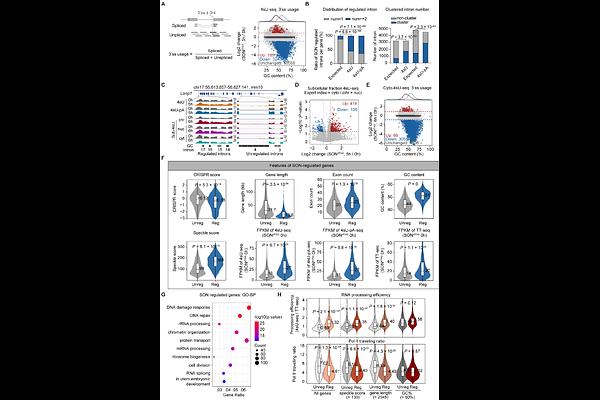
AbstractGene architecture in higher eukaryotes exhibits substantial heterogeneity. While most genes follow a canonical pattern of GC-rich exons and AT-rich introns, a subset displays GC-leveled architecture, characterized by uniformly high GC content across both exons and introns. These genes are often associated with nuclear speckles, membraneless compartments enriched in RNA-processing factors, yet the mechanistic basis of this spatial and functional relationship remains unclear. Here, we identify the nuclear speckle protein SON as a critical factor that safeguards the splicing of GC-rich genes. Acute depletion of SON in mouse embryonic stem cells selectively impairs the splicing of short, GC-rich introns. These SON-dependent introns are enriched in highly expressed and functionally essential genes, whose GC-rich architecture contributes to efficient RNA processing and expression. Mechanistically, these introns harbor atypical C-rich, U-poor polypyrimidine tracts at their 3' splice sites, which exhibit reduced affinity for core splicing factors. SON is recruited to these sites via U2 snRNP and further interacts with SR proteins to stabilize the association of U2 snRNP and U2AFs at these C-rich weak splice sites. Notably, the evolutionary expansion of SON's intrinsically disordered region is required to promote efficient splicing of GC-rich genes that emerged during evolution. Together, our study suggests that the evolutionary transition toward GC-rich gene architecture enhances gene expression efficiency, with SON acting to safeguard the splicing of this gene class.