Voltage-Gated Sodium Channel Modulation Differentially Alters ON and OFF Bipolar Cell Contributions to the Rat ERG

Voltage-Gated Sodium Channel Modulation Differentially Alters ON and OFF Bipolar Cell Contributions to the Rat ERG
Bellare, J.; Pai, A. V.; Kulkarni, Y.
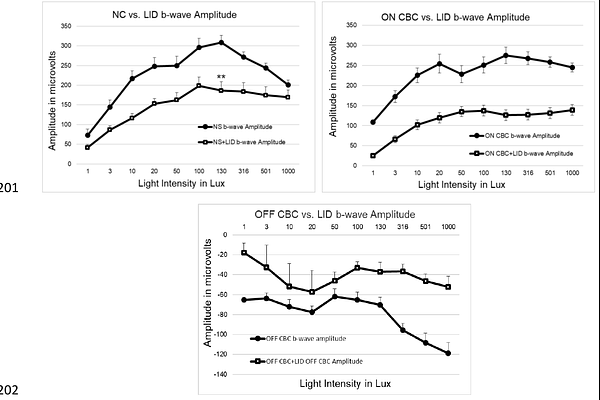
AbstractAim: The ERG "b wave" is primarily attributed to ON bipolar cell activity, while the contribution of the OFF pathway and the differential role of voltage gated sodium (NaV) channels in these pathways remain unclear. This study investigated whether pharmacological modulation of NaV channels differentially alters ON and OFF cone bipolar cell responses and ERG "b wave" amplitudes. Methods: Dark and light adapted ERGs were recorded from rats across stimulus intensities spanning rod, mixed rod plus cone, and cone pathways (1 to1000 lux). ON and OFF cone bipolar cell pathways were pharmacologically isolated using intravitreal cis PDA. NaV channel activity was modulated via intravitreal administration of lidocaine and lamotrigine (blockers) and veratridine (agonist). Changes in "b wave" amplitudes were analysed to assess "pathway specific" effects. Results: Both lidocaine and lamotrigine significantly globally reduced ERG b-wave across all stimulus intensities, confirming a role for NaV channels in bipolar cell signalling. Pathway isolation revealed differential effects: lidocaine predominantly suppressed ON pathway, whereas lamotrigine preferentially reduced OFF pathway responses. In contrast, veratridine enhanced both ON and OFF pathway activity. These findings indicate that NaV channel activity in ON and OFF cone bipolar cells can be independently and differentially modulated. Conclusion: The ERG b-wave reflects integrated contributions from both ON and OFF cone bipolar cells. Differential NaV channel modulation alters these pathways distinctly, highlighting sodium channel mediated mechanisms as potential targets for physiologically relevant retinal stimulation strategies in degenerative retinal conditions.