Activity and specificity trade-offs in adenine base editors

Activity and specificity trade-offs in adenine base editors
Lukarska, M.; Oltrogge, L. M.; Nisonoff, H.; Long, Y.; Terrace, C. I.; Busia, A.; Aquino, C.; Kim, S. E.; Listgarten, J.; Savage, D. F.
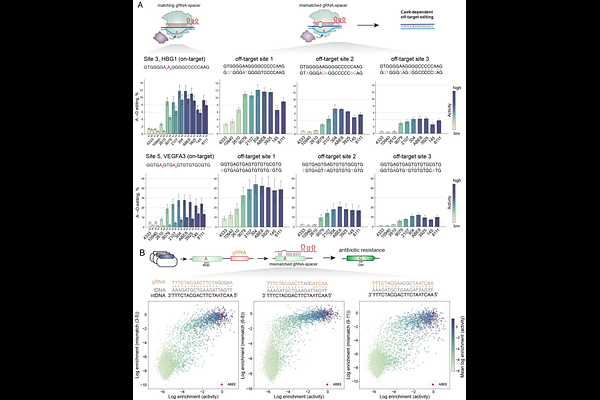
AbstractAdenine base editors (ABEs) are CRISPR effectors that introduce A-T to G-C transitions in the genome using a nucleotide deaminase fused to a Cas protein. ABEs have been evolved to have very high editing efficiency, but off-target editing effects compromise their precision and hinder their applications. Here we explore the activity and specificity relationship of ABEs using a combination of machine learning-guided design and high-throughput screening. We designed a diverse library of 12,000 variants and built quantitative bacterial selection systems that allowed us to simultaneously measure their on-target and off-target editing. We found that the ABEs were fully described by the single dimension of intrinsic deaminase activity with no evidence for independent specialization with respect to local sequence context, editing window width, RNA editing, or genotoxicity. These results were supported by in vitro studies and consistent with editing experiments in mammalian cells. Finally, the activity and specificity trade-offs were recapitulated among previously reported engineered variants and a selection of library variants spanning the activity spectrum. Our results suggest that fundamental architectural improvements will be necessary to transcend the activity and specificity limitations for the next generation of ABEs.