Mutation of eat-2 in C. elegans is not a reliable model for dietary restriction studies

Mutation of eat-2 in C. elegans is not a reliable model for dietary restriction studies
Wang, H.; Zhao, Y.; Athar, F.; Lohr, J. N.; Zhang, B.; Marcu, I.; Penzel, M.; Gems, D.
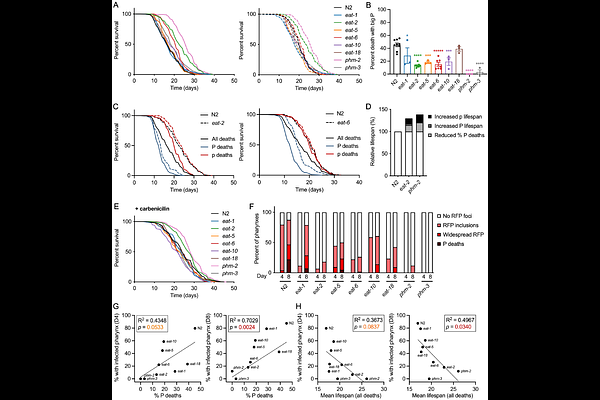
AbstractDietary restriction (DR) extends lifespan in many animal species. In C. elegans, Eat mutants with pharyngeal defects that impair feeding exhibit reduced growth rate and fertility and are typically long-lived, suggesting a DR effect. We report that Eat mutant longevity is largely or wholly a consequence of suppression of feeding activity-dependent infection of the pharynx by their E. coli food source. eat-2 mutants, widely used as a DR model, were among only 2/8 Eat mutants tested whose longevity were to any degree independent of bacterial infection. Moreover, among Eat mutants, phenotypic indicators of reduced nutrition correlated with one another, yet not with longevity. Thus, eat-2 longevity is partially due to infection resistance rather than DR, and residual, infection-independent longevity could equally reflect DR or some other consequence of their cholinergic signaling defect. We therefore conclude that eat-2 mutants are not at present a trustworthy model for studies of DR.